The registre RGPD, or GDPR register of processing activities, is the central inventory documenting all personal data your business handles. It's a non-negotiable legal requirement under Article 30 that details what data you collect, why you collect it, and how you protect it, forming the foundation of your compliance strategy and cybersecurity posture.
Unpacking the Registre RGPD: Your Master Data Inventory

For most SMBs and startups, the term "registre RGPD" sounds like another legal headache—a box-ticking exercise that drains resources with no clear return. But this view is a critical mistake. Your register is far more than a compliance document; it's the master blueprint of your company's entire data ecosystem and a foundational pillar of your security. It is a living document that maps every flow of personal information, from a customer's email in your CRM to an employee's payroll details.
This register forces you to answer the tough questions about your data practices. Without it, you’re flying blind, unable to prove control over the data entrusted to you by customers and partners. This isn't just a compliance gap; it's a massive business risk, leaving you exposed to crippling fines, lost deals, and severe reputational damage.
More Than Just a Legal Document
A well-maintained register is a powerful strategic asset that gives you clarity and control. For an SMB, its real value lies in helping you:
- Map Data Flows & Identify Risks: Get a clear picture of where data comes from, where it goes, and who has access. This process uncovers "shadow IT," unauthorised software, and risky data storage you never knew existed.
- Accelerate Sales Cycles: Confidently answer security questionnaires from large clients who demand proof of GDPR compliance. A solid register is your evidence.
- Build Customer & Investor Trust: Demonstrate a transparent, professional approach to data protection that builds confidence.
- Prepare for Audits: Have an organised, up-to-date record ready for inspection by authorities like the CNIL, or for certifications like ISO 27001 and SOC 2.
The register isn't about bureaucracy; it's about operational control and accountability. It's the tangible proof that you understand your data responsibilities and have a structured plan to protect your business.
The Reality of Compliance in France
The push for GDPR compliance is accelerating. While nearly 47% of French companies report satisfactory compliance, a major pain point remains: 56% cite a lack of time as their biggest barrier. This is where manual processes fail.
Slowly, companies are adapting. The digitisation of the registre RGPD grew from just 14% in 2019 to nearly 30% by 2022. The CNIL enforces these obligations strictly, with sanctions ranging from €3,000 to €90 million. You can discover more insights about French companies and the GDPR on ellisphere.com.
The message is clear: managing your register effectively isn't optional. It's the first and most critical step toward robust data protection, enabling you to build trust and secure your business's future.
Decoding Article 30 and Your Legal Obligations
Article 30 of the GDPR is the legal foundation for the registre rgpd. Don't get intimidated by the legalese; it's a set of instructions on what to document about your data handling. For startups and SMBs without a dedicated legal team, understanding these instructions is the first step to avoiding costly mistakes.
A dangerous myth persists that only large corporations need a register. The regulation mentions an exemption for organisations with fewer than 250 employees, but the exceptions are so broad they ensnare nearly every modern business.
So, Who Actually Needs to Keep a Register?
That "250 employees" figure is a trap. The obligation to maintain a register is triggered if your data processing meets just one of the following conditions, making the exemption practically irrelevant for most businesses:
- The processing is not occasional: Do you manage a customer database? Send marketing emails? Handle employee payroll? If processing personal data is part of your regular business operations, you need a register. For virtually any active company, data processing is never truly "occasional."
- The processing involves sensitive data: If you handle "special categories of data," the register is mandatory, regardless of your company size. This includes data revealing racial or ethnic origin, political opinions, religious beliefs, trade union membership, genetic or biometric data, or health information.
- The processing could pose a risk: This is a broad but critical clause. Any activity that might create a risk to people's rights and freedoms—like customer profiling, location tracking, or handling data from vulnerable individuals—requires a register.
With these exceptions, the question for most SMBs isn't if you need a registre rgpd, but what specific information must go into it.
The reality is simple: if your business handles personal data as part of its operations, you are almost certainly required to maintain a register. Assuming you're exempt is one of the costliest compliance mistakes a startup can make.
Controller vs. Processor: What’s Your Role?
Another key pain point is understanding your role. Your documentation duties differ depending on whether you're a data controller or a data processor.
A Data Controller is the organisation that decides why and how data is processed. If you run a SaaS platform, you are the controller for your customers' account information.
A Data Processor is a company that processes data on behalf of the controller, following their instructions. Cloud providers like AWS or marketing platforms like Mailchimp are classic processors.
Many startups and SMBs wear both hats:
- You are a controller for your own employee and customer data.
- You are a processor if you provide a B2B service where you handle data on behalf of your clients.
Getting this distinction right is crucial. Article 30 has different documentation requirements for each role. A controller’s register focuses on the purposes and legal basis for processing, while a processor’s register details the activities performed for each controller. Nailing this ensures your register accurately reflects your legal responsibilities.
Building Your Registre RGPD Step by Step
Let's turn the legal theory of the GDPR into an actionable plan. Creating your registre RGPD can feel overwhelming, but breaking it down into logical steps makes it manageable. This isn't just about satisfying regulators; it's about creating a detailed map of how personal data flows through your business—a map that strengthens your security and operational efficiency.
This section is your practical guide to building that map. We'll tackle one of the biggest pain points: knowing exactly what information to record for every single data processing activity. We’ll walk through the mandatory fields, turning this abstract legal requirement into a clear, step-by-step process.
First, a quick reminder of who needs a register. The flowchart below shows that the obligation applies to almost every active business.
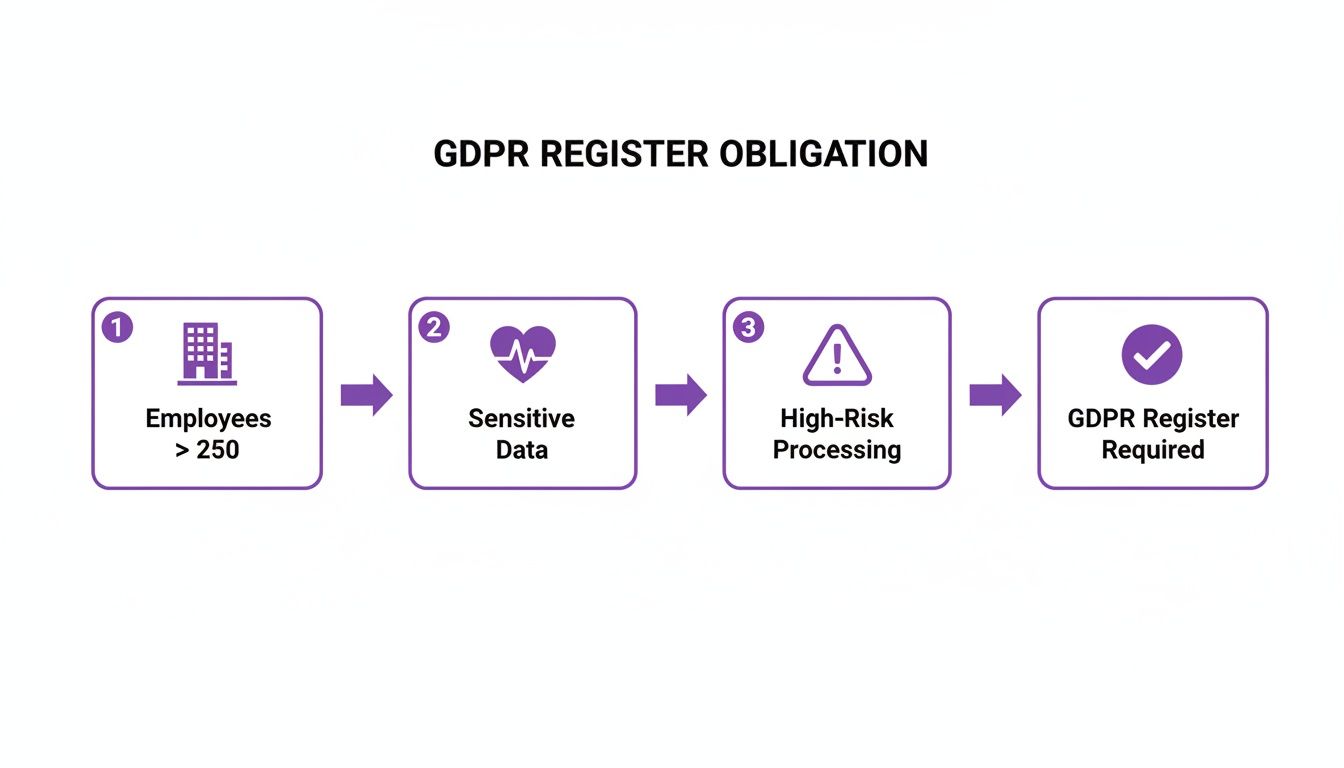
As you can see, having fewer than 250 employees offers little protection if you engage in regular data processing, handle sensitive data, or perform activities that could pose a risk.
First Things First: Identify Your Processing Activities
Before you can document anything, you need a complete inventory. A "processing activity" is any operation you perform on personal data for a specific purpose. It's not one giant bucket labelled "customer data."
In a typical SMB or startup, common examples include:
- Customer Relationship Management (CRM): Managing leads, contacts, and sales opportunities.
- E-commerce Order Fulfilment: Processing payments, managing shipping, and handling returns.
- Newsletter Marketing: Collecting emails and sending marketing communications.
- Human Resources Management: Handling employee payroll, recruitment, performance reviews, and benefits.
- Product Analytics: Tracking user behaviour within your application to improve the service.
Your first step is to list every distinct activity. For a small organisation, this list might have 10 to 30 entries. This foundational step is often skipped, which is a critical error. A shocking 84% of SMBs facing their first audit have no register, often because they never mapped their activities in the first place.
The Devil Is in the Details: Filling In the Mandatory Fields
Once you have your list of activities, you need to populate the required details for each one. Let's use a common example: a startup's CRM for managing sales leads.
Example Scenario: "CRM Lead Management" Activity
For this single activity, your registre RGPD must contain the following fields, as required by Article 30:
- Name and Contact Details of the Controller: Your company's legal name and the contact info for your data protection lead.
- Purpose of the Processing: Be specific. "Sales" is too vague. A compliant entry would be: "To manage prospective client communications, track sales pipeline progress, and follow up on inbound leads."
- Categories of Data Subjects: Who are the individuals? For this activity, it would be "Prospective B2B Clients" and "Website Visitors who submitted a contact form."
- Categories of Personal Data: What exact information are you collecting? List it clearly: "Name, professional email address, phone number, company name, job title, communication history."
- Categories of Recipients: Who has access to this data? This includes internal teams and external vendors (sub-processors). For our CRM, it would be the "Internal Sales Team, Marketing Team, and our CRM software provider (e.g., Salesforce)."
- International Data Transfers: Is the data sent outside the EU/EEA? Many SaaS tools are US-based. Your entry must state: "Data is transferred to our CRM provider in the United States, protected by Standard Contractual Clauses (SCCs)."
- Data Retention Periods: How long will you keep it? Define a clear rule: "Lead data is retained for 3 years after the last meaningful contact, after which it is anonymised or deleted."
- Technical and Organisational Security Measures: Briefly describe your security controls. For example: "Access control with role-based permissions, data encryption at rest and in transit, and mandatory multi-factor authentication for CRM access."
Completing these fields for every processing activity is the core of building a compliant register. It creates a transparent, detailed record that proves your organisation understands and controls its data.
By methodically applying these fields to each activity, you build a comprehensive and defensible registre RGPD that stands up to auditor scrutiny and serves as a true asset for managing your business securely.
Moving from Manual Spreadsheets to Automated Compliance
For many SMBs, the default tool for their first registre rgpd is a spreadsheet. While it seems like a simple starting point, relying on a manual register is like trying to manage your company’s finances in a notebook. It’s a static, error-prone method that quickly becomes a significant operational bottleneck and a major compliance risk.
Spreadsheets are not designed for dynamic compliance management. They are prone to human error, impossible to keep current, and offer zero real-time visibility into your data risks. Every time a new SaaS tool is adopted or a process changes, someone has to remember to manually update a file. This creates a dangerous gap between your documented policies and your actual operations.
The Pain Points of a Static Register
The fundamental problem with a spreadsheet register is that it's a dead document. It can't alert you to new risks, track changes automatically, or connect your data map to your wider security efforts. This manual burden is a huge pain point for lean teams:
- It's Always Out of Date: A marketer adds a new analytics tool, and your register is instantly non-compliant. A recent study found 78% of SMBs lack a clear procedure for handling security incidents—a process impossible to manage with a static document.
- No Real-Time Visibility: A spreadsheet can't answer critical business questions like, "Which vendor poses the highest risk?" or "How is data flowing between our systems right now?"
- It's a Massive Time Sink: Manually updating dozens of activities consumes countless hours that could be spent on strategic security initiatives that actually reduce risk.
- Collaboration is a Mess: Version control becomes a nightmare, with different teams working from outdated copies.
Sticking with a manual process traps your security program in a reactive state, always playing catch-up. To transform compliance from a burden into a strategic advantage, automation is the only sustainable path forward.
Transforming Your Register into a Dynamic Asset
This is where compliance automation platforms change the game. They convert the registre rgpd from a static document into the central command center of your data governance strategy. These tools create a living record of your data processing that automatically adapts as your business evolves.

Instead of static rows, you get an interactive system that connects your register directly to your entire security framework.
An automated register doesn't just document your compliance; it actively powers it. It connects your data mapping to vendor risk, policy management, and even security questionnaires, turning a legal requirement into a business enabler.
Seamless Integration with Security Frameworks
The true value of automation becomes clear when you connect your register to other compliance frameworks. SMBs rarely deal with just GDPR. They're often juggling requirements for ISO 27001, SOC 2, NIS 2, or DORA to win enterprise deals. A well-maintained registre rgpd is the foundational data map for all of them.
An automated platform builds these connections for you:
- The data flows mapped in your register directly inform the risk assessment required for ISO 27001.
- Your list of data processors is essential for managing third-party risk under SOC 2 and answering security questionnaires.
- Clear documentation of security measures helps you prove your controls are effective during any audit.
By automating your register, you create a single source of truth that feeds your entire security program. It stops being an isolated task and becomes the engine that helps you close deals faster, manage vendor risk effectively, and demonstrate compliance across multiple frameworks with confidence. If you're exploring tools in this space, our guide on the 5 best Vanta alternatives offers key insights into the market.
Keeping Your Register Accurate and Audit-Ready
Creating your registre RGPD is a critical first step, but it's not the end of the journey. The real challenge—and where most businesses fail—is keeping it alive. A register is not a one-and-done project; it's a living document that must evolve with your business.
Think of your register as a real-time map of your data operations. The moment you onboard a new SaaS tool, launch a new feature, or change a process, that map becomes outdated. Maintaining this document as a central source of truth is what separates businesses that are truly compliant from those just going through the motions.
A Practical Checklist for Periodic Reviews
To prevent compliance drift, schedule regular reviews. For most SMBs, a quarterly review is the right cadence—frequent enough to catch changes before they become unmanageable.
Use this actionable checklist for your review:
- Validate All Processing Activities: Are all listed activities still active? More importantly, have new activities emerged, like a customer feedback tool or a new marketing campaign?
- Check Data Categories: Are you collecting new types of personal data? Did a product update introduce location tracking or other new data points?
- Review Third-Party Vendors: Is your list of sub-processors still accurate? Cross-reference it with your finance department’s software subscription records to uncover "shadow IT."
- Confirm Data Transfers: Re-verify the legal basis for any international data transfers. This landscape is constantly changing, so you can't "set it and forget it."
- Update Retention Periods: Are your documented retention periods actually being enforced in your systems?
Triggers for Immediate Updates
Beyond scheduled reviews, certain events should trigger an immediate update to your registre RGPD. These are critical moments of change that directly impact your risk profile.
Act immediately when you:
- Onboard a New Vendor: Any new software that processes personal data must be added right away.
- Launch a New Product or Service: If a new offering collects or uses personal data, it must be documented before launch.
- Change a Data Storage Provider: Migrating from one cloud service to another is a major change that must be reflected.
- Implement New Internal Processes: A new HR system or internal helpdesk tool requires an entry if it handles personal data.
A well-maintained register is your first line of defense. In the event of a data breach, it provides immediate, credible proof of your data governance efforts and can significantly influence the outcome of an investigation.
Recent CNIL reports show a sharp rise in personal data breaches, leading to more inspections and multi-million euro fines. An accurate register is your key to demonstrating accountability and mounting a swift, organised response when an incident occurs. You can get a sense of the current enforcement climate by reading the full CNIL annual report.
This proactive maintenance also supports other critical frameworks. The detailed mapping of vendors and data flows is a core requirement for achieving SOC 2 Type 2 compliance. By keeping your register current, you build a resilient data governance program ready for any challenge.
A Few Common Questions About the GDPR Register
Getting to grips with the registre RGPD often brings up a few tricky questions. Let's tackle some of the most common ones we hear from startups and growing businesses to clear up any confusion.
Do I Really Need to Include Employee Data in My Register?
Yes, absolutely. This is a common and costly oversight. The GDPR protects the personal data of everyone, including your own employees. Your register must document all HR-related processing activities.
This includes everything from payroll and benefits management to performance reviews and recruitment. Data protection authorities pay close attention to how organisations handle employee data, making this section of your register as critical as your customer data records.
How Detailed Should My Processing Descriptions Be?
They need to be crystal clear. Imagine an auditor from the CNIL is reading it—they must understand precisely what you are doing with the data without asking for clarification. Vague descriptions like "Marketing" are red flags that invite further investigation.
A compliant entry looks like this: "Collecting customer emails via our website’s opt-in form to send a monthly promotional newsletter using our designated email service provider." The goal is total transparency. Detail the purpose, the process, and the key tools involved.
A good rule of thumb: write each entry as if you were explaining it to a regulator standing right in front of you. If it wouldn't be clear to them, it's not specific enough.
Can I Just Download a Template and Be Done With It?
A template is a great place to start, but it's just a starting point. Think of it as an empty bookshelf; it provides the structure, but you must fill it with the books that accurately represent your company's unique activities.
To be compliant, your registre RGPD must be a bespoke inventory of your specific data flows, systems, and vendors. Submitting a generic, incomplete template during an audit is no better than having no register at all. You can learn more about building a solid compliance programme over on the Compli.st blog.
What Happens If I Don't Have a Register During an Audit?
Failing to produce a register on demand is a direct and serious breach of Article 30. It's often the first document a data protection authority requests, and its absence signals a fundamental failure in your data governance.
The penalties are severe. This failure alone can trigger fines of up to €10 million or 2% of your global annual turnover—whichever is higher. This applies even if no data breach has occurred. The lack of a register is an offence in and of itself.
Maintaining your registre RGPD and overall compliance doesn't have to be a manual struggle. Compli.st automates the creation of your Article 30 register, maps your data flows, and helps you integrate compliance across other frameworks like ISO 27001 and SOC 2. It’s time to turn compliance from a chore into a real asset. Discover how Compli.st can help you build and maintain an audit-ready compliance programme.