At its core, privacy by default is a simple yet powerful principle: make the most private and secure settings the standard, right out of the box. This means your users are automatically granted the highest level of privacy protection the moment they start using your product, without ever having to touch a settings menu. For SMBs and startups, this isn't just a legal requirement; it's a critical strategy to close bigger deals, pass security questionnaires, and build a trustworthy brand.
Why Privacy by Default Is Your New Competitive Edge

For growing SMBs and startups, treating privacy by default as a core feature is a game-changer. It’s not just about ticking a compliance box; it's a strategic decision that builds deep customer trust and can genuinely speed up your sales cycle.
When your product respects user data from day one, you transform a legal obligation into a powerful selling point. This proactive approach is precisely what sophisticated enterprise clients are looking for when they send over those dreaded, lengthy security questionnaires. Instead of scrambling to justify your security, you get to showcase it.
This isn't just a good idea—it's codified in law. Regulations like the GDPR explicitly require it under Article 25, "Data protection by design and by default." This article mandates that companies must have technical and organisational measures in place to ensure that, by default, only personal data absolutely necessary for each specific purpose is ever processed.
The Critical Difference: Privacy by Design vs. Default
People often use "privacy by design" and "privacy by default" interchangeably, but they represent two different stages of the same philosophy. Understanding the distinction is key to solving real business problems.
Here’s a simple analogy: think of building a house.
- Privacy by Design is the architectural blueprint. It’s about embedding data protection into the very foundation of your project. From the initial sketch to the final build, you’re proactively designing systems to prevent privacy risks before they can even materialise. This is your strategy.
- Privacy by Default is the setting on the front door lock when you hand over the keys. It ensures the door is already locked (the most secure state) by default. The new owner doesn't have to figure out how to lock it or remember to do it; security is the factory setting. This is your execution.
This table breaks it down further:
Privacy by Default vs. Privacy by Design
| Concept | Privacy by Design | Privacy by Default |
|---|---|---|
| What it is | A holistic methodology for embedding privacy into the entire system architecture and development lifecycle. It’s the how. | A specific implementation of privacy by design that ensures user settings are pre-configured to be the most privacy-protective. It's the result. |
| Scope | Broad and strategic. It covers architecture, policies, features, and organisational culture. | Narrow and tactical. It focuses on the default state of settings, permissions, and data sharing options. |
| Analogy | Designing a car with safety features like airbags, seatbelts, and a reinforced frame. | The car's headlights automatically turn on in the dark, ensuring a basic level of safety without driver intervention. |
| Example | Building a feature that uses anonymised data from the start, rather than collecting personal data and trying to anonymise it later. | A social media app where a new user's profile is set to "private" by default, instead of "public." |
In short, privacy by default is a direct, tangible outcome of a successful privacy by design strategy. It makes the most protective choice the easiest one for the user—often requiring no action at all.
A Business Imperative, Not a Legal Burden
For startups and SMBs, it’s crucial to see this through a business lens. A strong default privacy posture smooths the path to achieving key certifications like ISO 27001, SOC 2 Type 2, NIS 2, and DORA. When auditors or potential customers ask how you protect data, you can point to concrete, system-level defaults instead of relying on optional user configurations. This builds instant credibility and shortens sales cycles.
Adopting a privacy-by-default mindset fundamentally changes how you answer security questionnaires. Instead of defending your practices, you get to showcase your commitment to customer data protection as a built-in feature.
This approach also aligns perfectly with modern customer expectations. Public awareness around data privacy has never been higher. A recent survey revealed that 69% of respondents pay close attention to how their personal data is processed online. This shows a clear market demand for services with built-in privacy.
Properly applying these principles is central to robust data governance. A cornerstone of this effort is maintaining accurate records of all data processing activities. You can learn more by checking out our guide on creating a GDPR register.
The Hidden Costs of Neglecting Default Privacy
Thinking that privacy by default is just a legal checkbox is a painful and expensive mistake. For SMBs and startups, this isn't a minor oversight; it’s a direct threat to your revenue, reputation, and ability to scale. These aren't abstract risks—they show up as very real roadblocks that can kill your momentum.
The pain points usually appear in three ways: lost deals, blocked certifications, and growing pressure from regulators.
When you don't build protective defaults into your product, you're creating immediate friction in your sales cycle. Large enterprise clients see weak privacy settings as a glaring supply chain risk. Their entire procurement process is designed to filter out vendors who could expose them to a data breach or a compliance nightmare like a failed ISO 27001 audit.
This is where it starts to hurt. Your sales team might spend months nurturing a promising lead, only to hit a wall at the security questionnaire stage. Vague answers about data protection or admitting that privacy settings are opt-in will set off major alarm bells. The deal dies, and all that effort goes down the drain.
The Straight Line from Weak Defaults to Failed Audits
It’s not just about individual sales. Neglecting default privacy makes it incredibly difficult to get key cybersecurity certifications. Frameworks like SOC 2 Type 2 and ISO 27001 aren't just about having policies on paper; they require hard evidence that those policies actually work in practice. Auditors will dig into your systems to see if data protection is truly built-in, not just an afterthought.
Picture this: an auditor asks how you ensure data minimisation.
- A weak answer: "Well, our users can go into their account settings and choose to limit the data they share." This response puts the responsibility on the user, which is exactly what auditors and enterprise clients don't want to see.
- A strong answer: "By default, our system only collects the three data fields absolutely necessary to provide the service. Additional data collection requires explicit, granular consent for each specific purpose. This is a core control for our SOC 2 and ISO 27001 certifications."
Without these baked-in protections, you simply won't have the evidence you need to pass an audit. That failure can lock you out of entire markets where these certifications are the price of entry, putting a hard ceiling on your growth.
For many growing businesses, the real cost of poor default privacy isn't some far-off fine—it's the guaranteed revenue you lose from deals you can't close and certifications you can't earn. Doing nothing creates a very real barrier to selling upmarket.
Regulatory Fines Are No Longer a Distant Threat
Finally, the regulatory mood has shifted from gentle guidance to serious enforcement. Data protection authorities are now actively going after services that don't offer privacy-protective settings right out of the box. The grace period is over. Regulators now expect to see clear proof of your default protections for frameworks like GDPR, NIS 2, and DORA.
This is particularly true in Europe. The CNIL (the French data protection authority) has made it clear that a lack of privacy-protective defaults is a key enforcement priority. They’ve already issued recommendations for mobile apps that will become the basis for enforcement actions starting in 2025, and have launched specific campaigns to check compliance with default settings. You can review the details of these upcoming enforcement trends and see for yourself how seriously regulators are taking this.
These actions are proof that regulators are on the hunt for non-compliance. The financial and reputational damage from a public enforcement action is far greater than the upfront effort it takes to get privacy by default right from the start. Being proactive is a smart investment; waiting is a massive, and growing, liability.
How to Put Privacy by Default into Practice
Knowing what privacy by default is and actually embedding it into your business are two different things. This is where the real work—and the real value—begins. For startups and smaller companies, this isn't about a massive budget. It’s about a cultural shift to make the most private option the default choice for your users.
This guide is a practical playbook, giving your teams high-impact, actionable steps you can take right away. By getting your default settings right, you lower your risk profile, earn user trust, and build a strong foundation for compliance frameworks like ISO 27001 and SOC 2 Type 2.
Ignoring these principles doesn't just risk a fine; it creates immediate business problems. Poor default settings lead to lost sales, blocked certifications, and eventually, financial penalties.
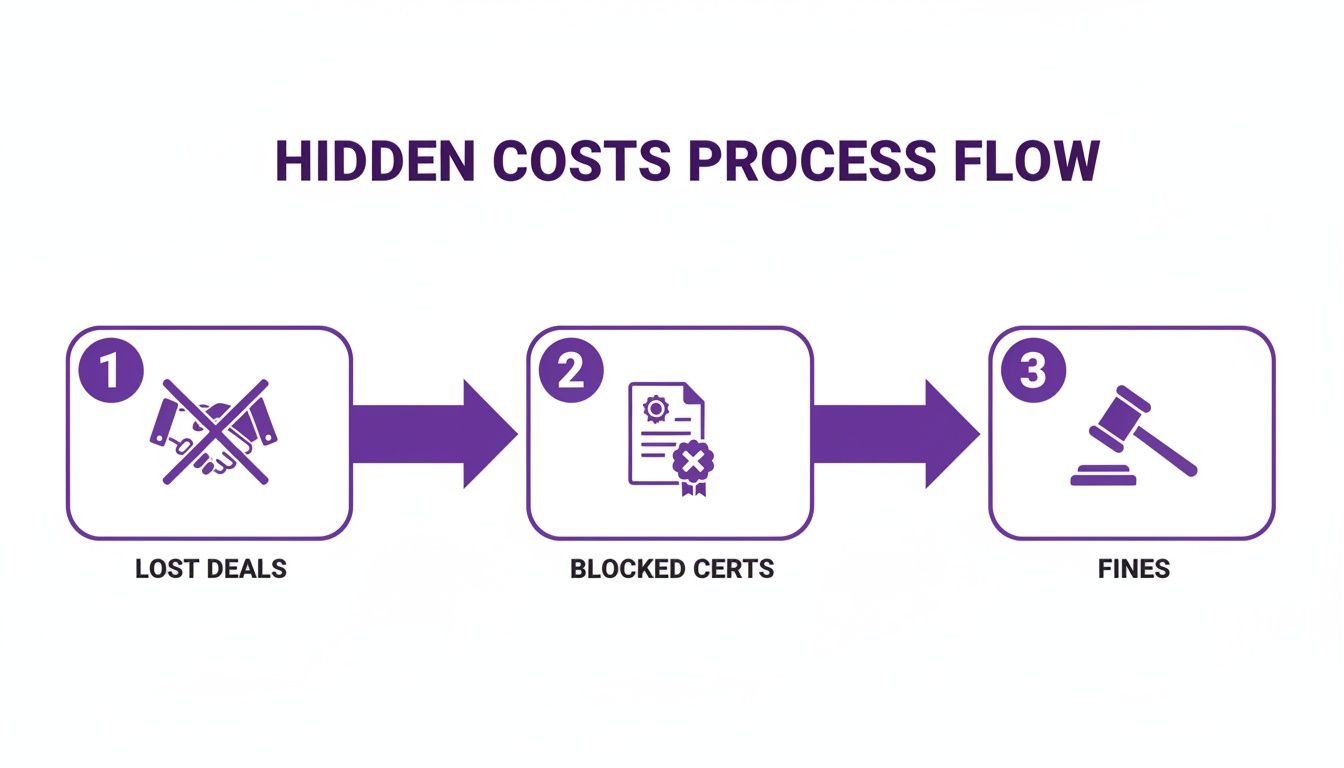
As you can see, the knock-on effects create a direct barrier to growth. They can hurt your sales pipeline and your ability to compete in regulated markets long before a regulator ever gets involved.
A Playbook for Product Teams
Your product team is on the front lines of implementing privacy by default. They shape the user experience, and their decisions determine whether privacy is a seamless part of your product or a confusing afterthought.
The guiding principle is straightforward: make the most private path the easiest one to take.
Here are a few concrete actions for your product managers and designers:
- Pre-select Private Options: On any settings page, toggles for non-essential data sharing (like marketing analytics or feature usage tracking) should be turned off by default. A user should have to actively opt in, not hunt for a way to opt out.
- Granular Consent Controls: Move away from a single, all-or-nothing consent checkbox. Instead, break down consent by its purpose. Use separate, unchecked boxes for "product improvement analytics" and "promotional emails."
- Minimalist Form Design: Take a hard look at every field on your sign-up and profile forms. If you don’t absolutely need a piece of information to deliver your service, don't ask for it. Every optional field you collect is a potential liability that complicates ISO 27001 or SOC 2 audits.
Here's the key takeaway for product teams: If a feature’s privacy relies on a user digging through settings to change something, you haven't achieved privacy by default. The safest state has to be the starting state.
Technical Implementation for Engineering Teams
Your engineers are the ones who turn privacy principles into functioning code. Their work ensures the promises made in the UI are backed by solid technical controls. This is where you can make a huge impact.
It’s been shown that addressing privacy during the design phase is 20-30 times cheaper than trying to patch vulnerabilities after a product is already live.
Here’s a checklist for your development and infrastructure teams:
- Shorten Data Retention Periods: Stop storing data indefinitely. Set up an automatic deletion policy. For example, customer support chat logs could be set to auto-delete after 90 days by default, rather than being kept forever. This is a key control for GDPR and SOC 2.
- Anonymise or Pseudonymise Logs: Application logs are notorious for containing sensitive data like IP addresses. Run scripts to automatically scrub this personal data before the logs are archived. This keeps users' data safe while still giving you what you need for debugging.
- Apply Data Minimisation at the Database Level: Don’t just rely on the front-end to limit data collection. Enforce it at the database schema level. If you only need a user's year of birth for age verification, create a field for the year only—not their full date of birth.
- Implement Strong Access Controls: Use Role-Based Access Controls (RBAC) to ensure your own employees can only see the minimum amount of data needed to do their jobs. Not everyone on the support team needs to view a user's entire activity history. This is a non-negotiable for ISO 27001.
Creating Privacy-First Business Operations
Finally, privacy by default needs to go beyond your product and into your internal business processes. Your operations and procurement teams have a critical role to play in making sure third-party tools don't become weak links in your privacy chain.
Making privacy-first defaults a non-negotiable for any new tool or vendor is a great place to start.
Follow these operational guidelines:
- Vendor Security Questionnaires: Before you buy any new software (like a CRM or marketing automation platform), send the vendor a security questionnaire. Ask them specifically about their default privacy settings and data retention policies. If they can't answer, they are a risk.
- Internal Policy Mandates: Create a simple procurement policy that states all new software must have its most privacy-protective settings enabled by default during setup. This makes it a standard part of onboarding any new tool.
- Regular Audits: Schedule periodic checks of your key third-party tools. You need to make sure their default settings haven't changed in an update and that they still align with your privacy standards for NIS 2, DORA, or SOC 2.
By embedding these practices across your business, you transform privacy by default from a buzzword to a core business function that accelerates growth, builds trust, and prepares you for compliance success.
How to Master Security Questionnaires Using Privacy by Default
Security questionnaires are a major pain point for SMBs. They’re detailed, demanding, and can stall a promising sales conversation for weeks. But what if you could turn them from a painful chore into a powerful sales tool?
That's exactly what happens when your organisation truly lives and breathes privacy by default. Instead of scrambling for answers, you get to put your mature, proactive security posture on full display. Every question becomes a chance to prove that protecting customer data isn’t just a policy—it’s baked into the DNA of your product. This lets you respond with confidence, speed up the sales process, and build instant trust with enterprise clients.
Turning Tough Questions into Trust-Building Answers
When a prospective customer asks how you protect user data, a vague, hand-wavy response just won't cut it. By grounding your answers in your privacy by default principles, you can provide concrete, evidence-backed responses that prove your commitment.
A strong answer moves beyond generic promises and points to specific, default settings that are active for every single user from the moment they sign up.
The real goal is to shift the conversation from, "Do you protect data?" to, "Here is how we protect your data by default." This immediately demonstrates control, transparency, and a deep respect for your client's own compliance needs.
This shift isn't just a good idea; it's what the market is demanding. Recent surveys show that 26% of the French population was classified as highly privacy-conscious in 2022. That means more than one in four of your potential customers are actively looking for services that default to stronger privacy protections. You can dig into more data privacy insights from StationX to understand this trend better.
Sample Security Questionnaire Responses
To make this tangible, let's look at how you can reframe common security questions by leading with your privacy by default controls. The difference between a weak, generic answer and a strong, specific one is night and day.
| Common Question | Weak Answer | Strong Answer (Citing Privacy by Default) |
|---|---|---|
| How do you ensure user data is protected? | "We follow industry best practices for security and have a privacy policy." | "We protect user data through privacy by default. All non-essential data processing is disabled by default, data is encrypted both in transit and at rest, and our systems only collect the minimum data necessary to provide our service, as required for our ISO 27001 certification." |
| What are your data retention policies? | "We retain data as needed for business purposes." | "Our default data retention period is 90 days for inactive user data, after which it is automatically anonymised or deleted. This data minimisation is a system-level default, ensuring we never hold onto data longer than necessary for our SOC 2 Type 2 and GDPR compliance." |
| How do you manage access to sensitive data? | "Access is restricted to authorised personnel." | "We enforce Role-Based Access Control (RBAC) by default. Employees are granted access on a 'least privilege' basis, meaning they can only view the specific data required for their role. These permissions are our default setting for all new team members." |
As you can see, the strong answers aren't just more detailed; they project a sense of control and intentionality that builds immediate confidence with potential buyers.
Preparing Your Evidence in Advance
The secret to acing questionnaires efficiently is having your evidence organised before the questions even land in your inbox. A well-curated library of proof points can turn a week-long fire drill into a quick, professional turnaround. This is especially critical for frameworks like SOC 2 Type 2, where you need to demonstrate that your controls are consistently effective over time. You can read our detailed guide to learn more about achieving SOC 2 Type 2 compliance.
Here are the essential evidence artifacts you should have on hand:
- Screenshots of Default Settings: Keep clear images from your application's admin panel or user settings page. These should show that privacy-protective options (like limited data sharing or marketing opt-outs) are pre-selected.
- Policy Documents: Have your Data Retention Policy, Access Control Policy, and Data Protection Policy ready to go. Be prepared to highlight the specific sections that mandate privacy by default.
- Technical Architecture Diagrams: Prepare diagrams that clearly illustrate your data flows. These should show where key controls like encryption and anonymisation are implemented by default.
- Code Snippets or Configuration Files: For highly technical questionnaires, having a few examples ready can be a game-changer. Think default data minimisation rules or automated data deletion scripts.
By organising these materials ahead of time, you not only answer questions faster but also provide irrefutable proof of your claims. This proactive approach flips the script on security reviews, turning them from a sales blocker into a genuine competitive advantage. You're no longer just a vendor; you're a trustworthy and secure partner.
How to Document and Automate Your Compliance Efforts
Putting strong privacy by default settings in place is a massive step, but it’s only half the job. For auditors, enterprise customers, and regulators, if you can't prove your privacy controls are active and working, they might as well not exist. This is why organised, auditable documentation is a fundamental part of any serious compliance programme.
Without a system for documenting your efforts, every security questionnaire or audit sends your team scrambling. This reactive firefighting wastes precious engineering time and creates unnecessary business risks. The goal is to evolve from a mess of scattered screenshots and documents into a centralised, automated compliance system that helps you sell more.
Creating Your Control Library
Think of a control library as your single source of truth for every security and privacy measure you have. It’s a catalogue that describes each control, explains its purpose, and links directly to the evidence proving it’s effective.
Start with your most critical privacy by default controls. For each one, capture these key details:
- Control Name: Give it a clear, descriptive name like "Default Data Retention Policy".
- Description: Briefly explain what it does and why. For example, "Automatically deletes user data after 90 days of inactivity to meet our data minimisation principle for GDPR and SOC 2."
- Evidence: Link to the proof. This could be a screenshot of the setting in your app, a link to the relevant section of your policy, or a snippet of code.
Building this library transforms your privacy posture from an abstract concept into a collection of concrete, verifiable controls. It becomes the bedrock for answering security questionnaires and provides the evidence needed for frameworks like ISO 27001 and SOC 2.
An organised control library is the difference between confidently proving your compliance and defensively trying to justify it. It builds immediate credibility with auditors and customers alike.
The Power of Compliance Automation Platforms
Managing a control library with spreadsheets and shared drives is a recipe for outdated information, human error, and bottlenecks that slow down both your sales and engineering teams.
This is exactly where a dedicated compliance automation platform comes in. These tools are built from the ground up to centralise your controls and automate the tedious process of collecting evidence, so you can focus on growing your business.
A platform like Compli.st acts as the central nervous system for your entire compliance programme. Instead of wrestling with spreadsheets, you can map each of your privacy by default controls directly to multiple compliance frameworks.
For instance, your data retention control doesn't just tick one box. A good platform automatically maps it to the relevant requirements across different standards:
- ISO 27001: It helps satisfy controls like A.8.10 and A.18.1.4.
- SOC 2: It aligns with the Privacy Trust Services Criteria.
- NIS 2 & DORA: It provides evidence for data lifecycle management and protection requirements.
- GDPR: It provides direct evidence for compliance with Article 25 and Article 5.
This "map once, use everywhere" model saves hundreds of hours and ensures your story is consistent across every audit. You stop reinventing the wheel and start operating with a proven, documented system that accelerates sales. You can even see how various platforms tackle this by checking out some of the best Vanta alternatives on the market.
By automating your documentation and evidence management, you shift compliance from a recurring cost centre into a strategic advantage. Your team gets to spend less time digging for proof and more time building the secure, trustworthy product your customers want to buy.
Turning Privacy Into Your Competitive Advantage
We’ve talked about the nuts and bolts of privacy by default, but let's focus on the bigger picture: this is about building a better, more profitable business. For an ambitious startup or SMB, making privacy a core part of your DNA is a direct investment in your brand and your ability to win.
From your customer's perspective, leading with privacy sends a clear message: we respect you, and you can trust us with your data. That trust is hard-earned and even harder for competitors to copy. It has a real impact on your bottom line. You'll fly through security questionnaires that stall your rivals, turning a painful sales roadblock into a chance to showcase your security maturity.
Adopting privacy by default isn't just about compliance; it's about building a resilient, trustworthy business that customers actively choose. This proactive stance is your most valuable asset for closing enterprise deals.
Getting this right from the start also sets you up for long-term success. The regulatory world never stands still. By building solid privacy controls now, you're already prepared for whatever comes next, whether that's frameworks like NIS 2 or DORA. You're building a business that's ready for the future, not just reacting to the present.
Ultimately, when you stop seeing privacy as a cost and start seeing it as a strategic advantage, everything changes. It becomes a tool that helps you win deals, accelerate your sales cycle, and build a company that people are proud to do business with. It’s how you build a brand that lasts.
Frequently Asked Questions
When it comes to putting privacy by default into practice, a few common questions always seem to pop up, especially for SMBs trying to scale. Let's tackle the most frequent ones.
Does Privacy By Default Mean We Cannot Collect Any User Data?
Absolutely not. This is a big misconception. The goal isn't to stop collecting data; it’s to make your data collection thoughtful, purposeful, and minimal. Privacy by default simply means you should only collect the data required for a specific, stated purpose.
You can still collect additional data if you have a solid legal basis, like explicit user consent. The shift is that data collection for anything non-essential (like marketing analytics) must be off by default. Your users have to actively choose to turn it on.
We Are A Small Start-up; Isn’t This Too Expensive To Implement?
It’s easy to think this, but the opposite is true. Tackling privacy by default from day one is one of the most cost-effective things you can do. Trying to bolt on privacy features after your product is already built is where the costs really spiral out of control.
For a startup, this is about making smart, low-cost choices early on that save you a fortune in re-engineering, failed audits, and lost deals down the line.
Think about these high-impact, low-cost steps:
- Set your standard data retention to 90 days instead of keeping it forever.
- When designing your sign-up form, ask only for what you absolutely need.
- Partner with third-party vendors who also practice privacy by default.
How Does This Principle Help With ISO 27001 or SOC 2?
Security frameworks like ISO 27001 and SOC 2 demand that you prove you have controls in place to protect personal data. Privacy by default gives you the concrete evidence you need to pass your audits without the last-minute scramble.
For example, Annex A control A.18.1.4 in ISO 27001 is all about protecting personally identifiable information. The SOC 2 Privacy Trust Services Criteria examines how you handle data from collection to deletion.
When an auditor asks how you're protecting customer data, you can point directly to your default settings. Your policies on data minimisation and purpose limitation aren’t just ideas; they're your tangible proof. Documenting these practices creates a clear audit trail that makes getting certified much easier and faster.
Ready to turn your privacy practices into a competitive advantage? Compli.st transforms compliance from a manual chore into an automated, sales-enabling process. Centralise your evidence, ace security questionnaires, and build a foundation of trust that helps you close deals faster.