A secure system development life cycle (SDLC) isn't just another industry acronym for your CTO to worry about. For a growing SMB or startup, it's a fundamental shift in how you build software that directly impacts your ability to close deals, pass audits, and build a trustworthy product. Instead of treating security as a final checklist item, it weaves security activities into every single stage of development, from the initial idea right through to long-term maintenance.
This philosophy ensures your application is secure by design. Think of it like building a house with fire-resistant materials and a modern alarm system from the ground up, rather than just hanging a fire extinguisher by the door after it's built. One approach is fundamental to its value and safety; the other is a reactive patch that nobody trusts.
Why a Secure SDLC Is a Strategic Advantage for SMBs

For startups and small businesses, the race to launch new features is relentless. The pressure from investors and the market makes it incredibly tempting to push security considerations to the side, promising to "deal with it later." This is a critical, and often costly, mistake that can stall your growth.
Developing software without a secure SDLC is like building a fintech app and only remembering to secure the transaction database after the grand opening. The product might look impressive, but it’s completely exposed to the very real threats that can kill a young company. This oversight isn't just a technical problem; it creates serious business risks that hit your bottom line hard.
The Real Cost of Insecure Development: Pain Points for Founders
Founders and CTOs learn this lesson the hard way. A weak security posture doesn't just create vulnerabilities; it actively slows growth and introduces operational chaos.
Here’s where the pain really shows up:
- Lost Enterprise Deals: Big clients have rigorous due diligence. They send detailed security questionnaires, and if you can't prove you have a formal secure system development life cycle, you're often disqualified on the spot. No proof, no deal.
- Failed Compliance Audits: Frameworks like SOC 2, ISO 27001, NIS 2, and DORA aren’t just suggestions. They demand documented proof of your security practices, and an ad-hoc approach simply won’t cut it, blocking your entry into regulated markets.
- Reputational Damage: A security breach can shatter the trust you've worked so hard to build. For a smaller company fighting to gain credibility, this can be a fatal blow.
In today's market, a robust secure SDLC isn't a 'nice-to-have' for tech companies. It's a non-negotiable ticket to play—essential for winning customers, passing compliance audits, and surviving for the long haul.
The numbers back this up. France's cybersecurity market has swelled to €3.8 billion and is growing by roughly 10% each year. With 61% of French companies reporting they've faced cyber-attacks, regulators are responding with tougher rules like NIS 2. You can learn more about the evolving digital economy in France here.
The good news? Building a secure SDLC doesn’t have to grind your development to a halt. This guide is your actionable playbook, breaking down the process stage by stage. We’ll show you exactly how to turn security and compliance from a burden into your most powerful competitive advantage.
A Practical Look at the Secure SDLC: Seven Stages
Thinking about the secure system development life cycle as one giant project is a surefire way to get overwhelmed. A far better way to tackle it is to break it down into manageable stages, each with its own set of security goals and activities. This approach turns a daunting concept into a clear, step-by-step roadmap for your engineering teams.
When you weave security into every phase, you build a layered defence that's not only stronger but also much cheaper to maintain. It's far better than frantically trying to patch vulnerabilities after your product is already out in the wild. Think of it as quality assurance, but specifically for security—building checks and balances in from day one.
Stage 1: Planning and Requirements
The journey to a secure product starts long before anyone writes a single line of code. In the planning and requirements phase, the focus is on defining what the system needs to do, not just from a functional standpoint, but from a security and compliance one, too. This is where you translate high-level security policies into concrete, actionable requirements for your team.
This means getting answers to some fundamental questions:
- What kind of data are we dealing with here? Is it sensitive personal information that falls under GDPR?
- Which regulations do we absolutely have to meet? Are we targeting clients who require SOC 2, ISO 27001, NIS 2, or DORA compliance?
- What are the non-negotiable security standards that every new feature must meet to pass an audit?
The main output of this stage isn’t code; it's clarity. You end up with user stories and functional requirements that have security baked right in. For example, a simple requirement like, "Users can reset their password," evolves into, "Users can securely reset their password via a time-limited link sent to their registered email, with brute-force protection in place." This is a core tenet of Privacy by Design, a topic we explore in our guide on implementing Privacy by Design principles.
Stage 2: Design and Architecture
Once you have your secure requirements locked down, the next job is to design a system architecture that can actually deliver on them. The single most important activity here is threat modelling. This is a proactive exercise where your team gets together to brainstorm potential threats and attack vectors before a single component is built.
Imagine an architect designing a new bank. They wouldn't just focus on how it looks; they would meticulously plan the location of vaults, cameras, reinforced doors, and alarm systems. Threat modelling is the software equivalent of that defensive mindset.
This process shines a light on potential weak spots—things like insecure data storage, flimsy authentication, or exposed APIs—and lets you design countermeasures directly into the system's blueprint. The resulting design documents become an essential guide for developers, ensuring the system is built on solid, secure foundations from the ground up.
Stage 3: Development and Coding
This is where the architectural blueprint starts to become a real product. The security focus during the development phase is all about writing resilient code and stopping common vulnerabilities from ever being introduced. This isn't just about developer skill; it’s a mix of good standards, ongoing training, and smart automation.
A few key activities make all the difference:
- Adopting Secure Coding Standards: Following established guidelines from organisations like OWASP helps developers sidestep common traps like SQL injection or cross-site scripting (XSS).
- Automated Dependency Scanning: Modern applications are built on the shoulders of open-source libraries. Tools that automatically scan these dependencies for known vulnerabilities are non-negotiable for supply chain security.
- Peer Code Reviews: Simply having a second pair of eyes—specifically looking for security flaws—can catch subtle issues that automated tools might miss. It’s a simple but powerful human check.
Stage 4: Testing and Verification
Now it’s time to try and break what you've built. The testing phase is about more than just making sure features work; it’s about actively simulating real-world attacks to find and fix security flaws before an attacker does.
Security testing isn’t just about finding bugs. It’s about verifying that the security controls you designed in Stage 2 actually hold up under pressure.
This stage brings in several types of specialised security testing:
- Static Application Security Testing (SAST): These tools analyse the source code for potential vulnerabilities without ever running the application. It's like proofreading an essay for grammatical errors.
- Dynamic Application Security Testing (DAST): This approach tests the live, running application to find vulnerabilities that only emerge during execution.
- Penetration Testing: This is a controlled, simulated cyber-attack conducted by security experts to identify and exploit weaknesses, just like a real attacker would.
Catching and fixing vulnerabilities at this stage is crucial before the application goes live. The increasing focus on these practices is reflected across the industry. France's software development sector, for example, is expected to hit €11.5 billion by 2025, a market built on the work of over 56,000 businesses. This growth is deeply intertwined with secure-by-design principles, especially as directives like NIS 2 push for stronger cybersecurity measures. You can dig into more data on the growth of France's software industry.
Stage 5: Deployment
Moving code into production is a high-stakes moment. Secure deployment is all about making sure this transition from a controlled testing environment to the live, public-facing one doesn't open up any new security holes. Key tasks include hardening server configurations, managing sensitive secrets securely, and ensuring the production environment itself is locked down.
Stage 6: Maintenance
Security doesn't stop at launch. Once an application is live, the maintenance phase is about continuous vigilance. This means actively monitoring for new threats, promptly applying security patches to servers and dependencies, and having a clear, rehearsed plan for what to do if a security incident does happen. A system that is consistently maintained is one that remains secure over time.
To pull all this together, it helps to see what these activities produce at each stage. This table summarises the key security tasks and the evidence—or artefacts—they generate throughout the lifecycle.
Key Security Activities and Outputs by SDLC Stage
| SDLC Stage | Key Security Activity | Example Artefact/Output |
|---|---|---|
| Requirements | Defining security requirements & compliance obligations. | Security-specific user stories, data classification policy. |
| Architecture | Threat modelling the system design. | Threat model diagram (e.g., STRIDE), data flow diagrams. |
| Coding | Writing code against secure standards, scanning libraries. | Secure coding checklist, dependency scan reports (SCA). |
| Testing | Performing SAST, DAST, and penetration testing. | SAST/DAST scan results, penetration test report. |
| Deployment | Hardening configurations and managing secrets. | Infrastructure-as-Code (IaC) templates, secret management logs. |
| Maintenance | Monitoring, patching, and incident response. | Vulnerability scan reports, patch management records, incident reports. |
These artefacts aren't just for internal use; they become the backbone of your compliance evidence. When an auditor for SOC 2 or ISO 27001 asks how you ensure secure development, you have a clear, documented trail of proof ready to go.
Mapping Your Secure SDLC to Key Compliance Frameworks
For any growing business, a solid secure system development life cycle does far more than just help you build better software—it builds trust. When big enterprise clients or sharp-eyed auditors start asking tough questions about your security posture, a well-documented SDLC is your best defence. It’s the organised, proactive proof that you take security seriously, turning what feels like a technical chore into a major win for your business.
Without it, responding to security questionnaires or prepping for an audit quickly turns into a frantic, all-hands-on-deck scramble. Your teams will waste precious hours digging through old logs and trying to piece together how and why decisions were made months ago. A mature secure SDLC completely flips that script. It makes audit preparation less of a fire drill and more of a routine exercise in presenting the organised evidence you already have.
The process of planning, designing, and developing with security in mind creates a clear and defensible trail.
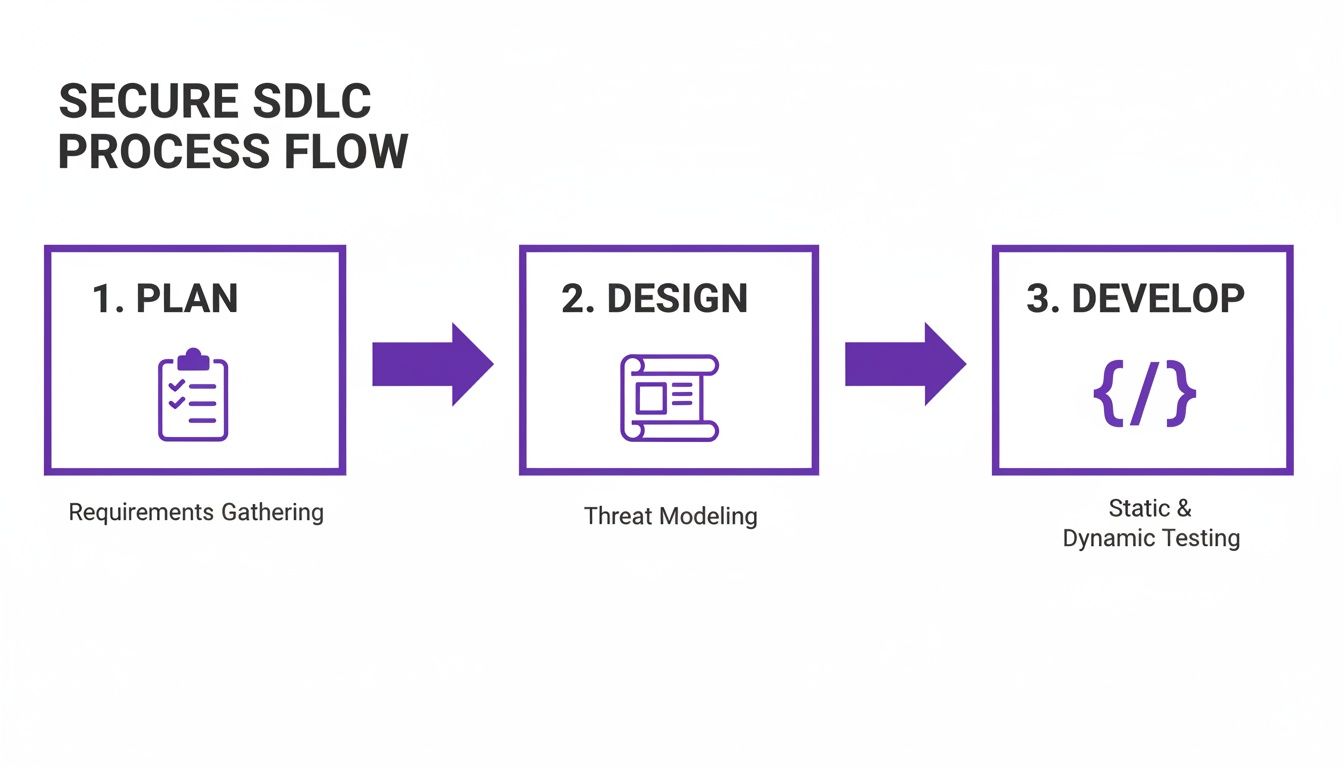
Every step here generates crucial artefacts—documents, reports, and logs—that directly answer the demands of compliance frameworks.
Connecting SDLC Activities to Compliance Controls
Different compliance frameworks might have their own particular flavours, but they all boil down to the same thing: proving you can manage risk and protect data. The day-to-day activities within your secure SDLC provide exactly the kind of tangible evidence needed to show you're meeting those obligations.
Think of your SDLC outputs as the building blocks of your compliance programme. Each artefact is a piece of evidence you can map to multiple controls across different standards, saving an incredible amount of time and effort.
Here’s how it works in practice with some of the most common frameworks SMBs face:
- ISO 27001: This standard is all about risk management. The threat models you create during the design phase are perfect evidence for control A.14.2.1 (Secure development policy) and its broader risk assessment requirements. This proves you are proactively identifying and mitigating risks.
- SOC 2: The Trust Services Criteria in SOC 2—especially around Security, Availability, and Confidentiality—are directly supported by SDLC practices. Vulnerability scan reports from testing prove you are continuously monitoring for threats (CC7.1), while your change management logs from deployment demonstrate clear control over the production environment (CC8.1).
Achieving a SOC 2 Type II certification, for example, sends a powerful message that you manage customer data securely, which is exactly what these frameworks are designed to verify.
Proving Security for NIS 2 and DORA
Newer regulations like the Network and Information Security (NIS 2) Directive and the Digital Operational Resilience Act (DORA) are raising the bar, putting a much stronger emphasis on supply chain security and operational resilience. A secure SDLC isn't just helpful here; it's fundamental.
- NIS 2: This directive requires organisations to implement robust security measures across their networks and systems. Having a formal secure SDLC, complete with secure coding standards and dependency scanning (SCA) reports, gives you the auditable proof needed to show you're managing software supply chain risks effectively.
- DORA: Aimed squarely at the financial sector, DORA demands that firms prove their digital operational resilience. The penetration test reports and incident response plans you generate during the testing and maintenance phases are critical pieces of evidence showing you can handle and recover from cyber-attacks.
A mature secure SDLC acts as a universal translator. It converts your team's daily technical work into the language of compliance that auditors and enterprise customers understand and require.
This mapping is far from a theoretical exercise. The next time a major potential customer sends over a lengthy security questionnaire, having this evidence organised and ready to go is a huge advantage. Instead of pulling engineers off critical product work, you can quickly provide the documentation they need, helping to close deals faster.
This is where having a central compliance platform really pays off. It can automate the collection of evidence from your development tools, map it to the right controls across multiple frameworks, and help you stay audit-ready at all times.
Sidestepping the Common Secure SDLC Pitfalls
Rolling out a secure system development life cycle is a major achievement, but the path from a great idea to everyday practice is often a bumpy one. For startups and smaller businesses, the hurdles can feel even higher. Just knowing the theory isn't enough; you have to anticipate the common traps to make it work.
If you don't tackle these issues head-on, you'll end up with wasted resources, frustrated developers, and a security programme that only looks good in a PowerPoint presentation. Let's dig into the most common problems and actionable solutions to keep you moving forward.
The Last-Minute Security Checklist
One of the most stubborn habits to break is treating security as a final checkbox just before going live. This "bolt-on" method is not just inefficient, it's a huge risk. It often forces teams to make an awful choice: either push a vulnerable product out the door on schedule or delay a crucial launch to fix problems that are now deeply embedded in the code.
This reactive way of thinking is the very thing a secure SDLC is meant to eliminate.
The whole point of shifting security left is to make it an ongoing conversation, not a final exam. When security is woven into the process from day one, it becomes everyone's job, and you end up with stronger, more dependable software.
A fantastic way to change this culture is by starting a security champions programme. Find developers on each team who have a genuine interest in security, then give them the extra training and authority to act. They become the security conscience for their squad, helping explain requirements and championing good habits from within.
Developer Overload and Tool Fatigue
In the rush to secure the development pipeline, it's all too easy to throw a mountain of security tools at your developers. When every single commit sets off a dozen different scanners, all screaming about low-priority issues with zero context, developers do what any sane person would do: they start tuning it all out. This "tool fatigue" completely defeats the purpose of integrating security into their daily work.
The key is to be deliberate about the tools you choose and how you integrate them.
- Insist on Actionable Alerts: Pick tools that give clear, helpful feedback right where developers live—inside their IDE or as a comment on a pull request.
- Automate What Really Counts: Focus your automation efforts on the big wins, like scanning for vulnerable dependencies (SCA) and running static analysis (SAST) for critical flaws.
- Create a Clear Triage System: Work with your teams to decide which alerts need an immediate fix and which can be scheduled for a later sprint. This stops the constant fire-fighting.
The Compliance Documentation Chasm
For many companies moving at speed, documentation is often the first casualty. This creates a massive problem when an auditor comes knocking or a big client sends over a security questionnaire. No matter how solid your security practices are, if you can't show the proof, they might as well not exist.
This isn't a theoretical risk. France's National Strategic Review 2025 highlights a significant rise in cyber threats targeting small and medium-sized enterprises. A recent international report, which France's ANSSI co-signed, goes further, directly calling for cybersecurity to be integrated throughout development to combat these systemic risks. The Building Trust in AI report gives a great sense of these growing expectations.
Closing this documentation gap means moving away from manual spreadsheets and towards collecting evidence systematically. Using templates for things like threat models or security requirements is a good start. Even better, a compliance platform that automatically pulls evidence from your development tools—think scan results, peer review approvals, and deployment logs—builds your audit trail as you work, without slowing anyone down.
Weaving Automation into Your SDLC for Security and Compliance

It's one thing to understand the theory behind a secure system development life cycle, but it's another thing entirely to put it into practice every single day. For most growing businesses, the reality is a painful, manual slog.
Engineers are constantly being chased for screenshots, audit season means digging through endless logs, and major sales deals get held up by lengthy security questionnaires. This approach isn't just slow; it's a huge drain on your most valuable resource: your engineering team. Every hour a developer spends on compliance grunt work is an hour they're not building your product. This old way of doing things is also riddled with the risk of human error, leaving your security programme in a constant, reactive firefighting mode.
The Central Nervous System for Security
What if you had a central hub that connected to all the tools your team already relies on? Think of it as the central nervous system for your security and compliance efforts, linking everything from code repositories like GitHub to project management tools like Jira and your vulnerability scanners.
This is where an AI-powered compliance platform comes in. Instead of someone having to manually collect evidence, the platform automatically gathers it as your team works. A pull request gets merged, a scan finishes, or a new server is configured—and the platform logs it, categorises it, and maps it directly to the relevant compliance controls for ISO 27001, SOC 2, and others.
This creates a single source of truth, offering a real-time, audit-ready snapshot of your security posture without slowing down development. The focus shifts from chasing paper trails to proactively managing security.
From Manual Drudgery to Intelligent Automation
The real magic happens when you pair this automated evidence collection with intelligent analysis and response generation. It completely changes how you manage the business-critical functions that depend on your secure SDLC.
Here are a few key capabilities that make this happen:
- Automated Evidence Ingestion: The platform integrates directly with your tech stack to pull in crucial security artefacts like code scan results, access logs, and infrastructure configurations. A core component here is a robust approach to reviewing code; incorporating both automated tools and manual expertise is essential, as detailed in these modern security code review practices.
- AI-Driven Risk Analysis: By constantly analysing this incoming data, sophisticated platforms can perform risk analysis that aligns with standards like ISO 27005. They automatically flag gaps and suggest prioritised actions for remediation.
- Instant Questionnaire Responses: The platform's AI can generate accurate, source-cited answers to security questionnaires in seconds. It draws from your live evidence library and documentation, which can dramatically speed up your sales cycle.
This level of automation transforms compliance from a roadblock into a genuine business accelerator. When looking at different platforms, it's worth comparing their capabilities to see what fits your needs, as some guides on the best Vanta alternatives point out.
By automating the tedious aspects of the secure SDLC, you free up your engineering team to focus on innovation. Compliance becomes a background process that enables growth, rather than a manual tax on every new feature.
The result is a state of continuous compliance. You're no longer scrambling to prepare for audits; you are always prepared. This builds a deep foundation of trust with your customers, helps you close deals faster, and gives your team the confidence to build secure, reliable products at speed.
Measuring the Success of Your Secure SDLC
So, you’ve put in all this work to build a secure system development life cycle. How do you actually prove it’s paying off? Without solid data, security can easily look like just another cost centre, a necessary evil that slows things down. To really show its worth, you need to translate your efforts into the language the business understands: concrete Key Performance Indicators (KPIs).
Tracking the right metrics is how CISOs and CTOs make a compelling case for their security programme. It’s how you demonstrate a tangible return on investment (ROI) to the board, justify the budget you need, and prove that security is actually helping the company grow, not holding it back. The entire goal is to put real numbers behind the effectiveness and maturity of your processes.
From Technical Metrics to Business Impact
Good KPIs bridge the gap between your team's day-to-day security work and what really matters to the business. It’s about moving past simply counting vulnerabilities and starting to measure their impact on development speed, operational efficiency, and even revenue. This shift in perspective is absolutely critical for getting leadership on board.
For instance, consider these key metrics that connect the technical details to business value:
- Mean Time to Remediate (MTTR): This isn't just a technical stat; it's a measure of your team's agility. How fast can you fix a critical vulnerability once it's found? A low MTTR shows your process is nimble and effective at stamping out risk before it can cause real damage.
- Vulnerability Density: Think of this as the number of confirmed flaws per thousand lines of code. If you see this number trending downwards over time, you have hard evidence that your secure coding training and standards are taking root and making a difference.
- Reduction in Security-Related Sales Blockers: Here's where security directly touches revenue. By tracking how often security or compliance questions slow down or kill a sales deal, you can draw a straight line from your secure SDLC to a healthier bottom line.
A mature secure SDLC doesn't just reduce risk; it becomes a sales enabler. When you can quickly provide evidence of your security posture, you remove friction from the sales process and build trust with enterprise customers faster.
The following table lays out some of the most important KPIs for measuring how your secure development efforts are maturing and impacting the business.
Essential KPIs to Measure Secure SDLC Maturity
| KPI Category | Metric | What It Measures |
|---|---|---|
| Efficiency & Speed | Mean Time to Remediate (MTTR) for critical vulnerabilities. | The agility of your development and security teams in responding to high-priority threats. |
| Code Quality | Vulnerability Density (defects per KLOC). | The effectiveness of secure coding standards and developer training over time. |
| Developer Productivity | Time spent by developers on manual compliance tasks. | The ROI of automation tools that free up engineering resources for innovation. |
| Business Enablement | Reduction in security-related sales blockers or delays. | The direct impact of your compliance programme on accelerating the sales cycle and closing deals. |
Ultimately, these KPIs aren't just for reporting. They are your guideposts, telling you what's working, where you need to invest more, and how security is transforming from a simple checkbox exercise into a genuine competitive advantage.
Frequently Asked Questions About the Secure SDLC
When teams start shifting towards a secure system development life cycle, a lot of practical questions come up. Let's walk through some of the most common ones I hear from development and security teams who are looking to build more robust security into their process.
What’s the Real Difference Between a Standard SDLC and a Secure One?
Think of it this way: a standard SDLC is all about getting a functional product out the door, on time and on budget. Security often gets bolted on at the end, usually when a penetration test flags something, or worse, after a breach. It’s a reactive, and frankly, very expensive way to handle security.
A secure SDLC flips that model on its head. It weaves security into every single stage, from the first brainstorming session to the final decommissioning. It’s about creating a proactive culture where security is everyone's job, ensuring the product is secure by design, not by accident.
How Can We Start a Secure SDLC With a Small Budget?
This is a big one, especially for startups. The good news is you don’t need an enterprise-level budget to make a real impact. The key is to be smart and focus on high-value, low-cost practices first.
Here are a few foundational steps you can take right now:
- Adopt Secure Coding Standards: Start with free, universally respected guides like the OWASP Top 10. They give your developers a clear roadmap for avoiding the most common and dangerous coding mistakes.
- Make Peer Code Reviews a Habit: This is a cultural shift that costs nothing but a bit of time. It’s one of the most effective ways to catch security logic flaws before they ever make it into a production build.
- Use Open-Source Scanning Tools: You can get a lot of mileage out of free tools for Software Composition Analysis (SCA). They'll scan your dependencies and alert you to known vulnerabilities in the third-party libraries you rely on.
What’s the Absolute First Step in Threat Modelling?
Before you can think like an attacker, you have to know what they'd want to attack. So, the single most important first step in threat modelling is identifying what you are trying to protect.
What are your crown jewels? Is it sensitive customer PII? Your proprietary algorithms? The uninterrupted availability of your service? Once you’ve clearly defined your most valuable assets, the entire exercise of brainstorming threats becomes much more focused, practical, and productive.
How Does a Secure SDLC Make Security Questionnaires Less Painful?
A well-run secure SDLC is your secret weapon for tackling security questionnaires from potential customers and partners. These reviews aren't just about promises; they demand concrete proof that you have security controls in place and are following them.
A documented secure SDLC provides a ready-made library of evidence. The threat models, scan reports, and secure coding policies you create aren't just for internal use—they are the exact artefacts auditors and enterprise clients need to see.
When you have this organised system, questionnaires stop being a frantic scramble for evidence. They become a routine task. You can pull the required documentation quickly, confidently demonstrate a mature security programme, and ultimately build the trust needed to accelerate your sales cycles.
An organised approach is what turns compliance from a headache into a real business advantage. Compli.st uses AI to automate evidence collection, centralise risk analysis, and generate accurate answers for security questionnaires in minutes. It helps you prove your security posture for frameworks like ISO 27001, SOC 2, NIS 2, and DORA to close deals faster. You can learn more at https://www.compli.st.