When you stack up getvera.ai against Compli.st, the fundamental difference comes down to their core philosophy. Getvera.ai is all about rapid questionnaire automation, while Compli.st provides an integrated compliance and sales enablement platform. Your decision hinges on a critical pain point: do you need a quick-fire tool to answer questionnaires, or a comprehensive system to build an audit-ready security programme that closes deals with enterprise clients?
Choosing Your AI Compliance Automation Partner
For startups and SMBs, the security questionnaire is a classic sales bottleneck. This single document can halt a promising deal in its tracks, consuming days of engineering and leadership time that you simply don't have. The pain is real: every hour spent on a questionnaire is an hour not spent building your product or talking to customers. This is the problem that AI-powered solutions like Getvera.ai and Compli.st solve—but they approach it from two very different angles, addressing different long-term business needs.
This guide provides a direct, pain-point-focused analysis to help CTOs, CISOs, and sales leaders choose the right partner. The choice isn't just about automation; it’s about investing in a platform that resolves your immediate sales friction while building a foundation for crucial certifications like ISO 27001, SOC 2, NIS 2, and DORA.
Getvera.ai vs Compli.st At a Glance
Before we dive deep, this high-level overview clarifies the distinct value proposition of each platform.
This table gives a quick snapshot of the two tools, highlighting their distinct approaches to solving your compliance headaches.
| Evaluation Criteria | Getvera.ai | Compli.st |
|---|---|---|
| Primary Focus | Rapidly completing security questionnaires. | Integrated compliance management and sales enablement. |
| AI Answer Philosophy | Uses AI models to generate answers from ingested data. | Requires source citations for every answer to ensure auditability. |
| Core Strength | Speed in responding to a high volume of vendor forms. | Building a verifiable, audit-ready compliance posture that accelerates enterprise sales. |
| Ideal User | Teams needing to accelerate sales cycles with minimal overhead. | Businesses building a foundation for SOC 2, ISO 27001, NIS 2, or DORA compliance to win larger deals. |
Ultimately, the table shows that one tool is built for speed, while the other is built for trust, verifiable accuracy, and long-term compliance management.

This kind of growth points to a broader market trend: businesses are actively seeking specialised solutions to handle complex, text-heavy workflows. The French AI market alone was valued at roughly USD 9.48 billion in 2024 and is expected to hit USD 77.68 billion by 2032. Security questionnaire copilots fall into the text-based AI companion category, one of the fastest-growing segments, which underscores the urgent need for tools that can automate security due diligence.
As you weigh your options, getting a handle on how different AI Workflow Automation Tools operate is key to making a smart investment. It's also helpful to see how these newcomers measure up against established players in the compliance automation space. For a wider perspective, take a look at our guide on the https://compli.st/blog/5-best-vanta-alternatives.
Comparing Core AI Capabilities and Answer Accuracy
The core of any AI compliance tool is its ability to generate accurate, trustworthy answers. When a major prospect drops a 200-question security questionnaire in your lap, the last thing you can afford is to submit AI-generated "hallucinations." The fundamental difference in the getvera.ai vs Compli.st debate lies in how each platform mitigates this risk, directly impacting your team's workload and your company's reputation.
getvera.ai operates by ingesting your existing security documents—policies, past questionnaires, audit reports—and using its AI models to generate answers. This approach is built for speed, helping teams create first drafts for a high volume of vendor forms.
The pain point, however, is the hidden cost of this speed: a heavy burden of manual verification. Your security or sales engineering team must meticulously review every AI-generated response. They aren't just proofreading; they are hunting for subtle inaccuracies or outright fabrications. The time saved on the initial draft can be quickly consumed by this critical, high-stakes verification step.

Compli.st's Smart Library and Source Citations
Compli.st takes a different, audit-first approach. Its central feature is the Smart Library. Instead of generating free-form text, the platform requires every answer to be directly tied to a specific, verified source document in your library—a direct quote from your ISO 27001 policy or a control description from your SOC 2 report.
This "source-of-truth" method solves two huge pain points for startups and SMBs:
- It eliminates AI hallucinations. Because the AI is constrained to only use pre-approved content, it cannot invent an answer. If the information isn't in the Smart Library, Compli.st flags it for human input rather than guessing.
- It guarantees auditability. Every response includes its own built-in audit trail. When a client—or an auditor—challenges an answer, you can instantly show them the exact policy or procedure it came from. This is how you demonstrate robust governance and build trust.
For a business pursuing its first SOC 2 or ISO 27001 certification, this isn't a feature; it's a lifeline. It transforms your questionnaire responses from a painful sales task into a living repository of verifiable compliance evidence.
As you weigh your options, knowing the key questions to ask AI vendors can help you cut through the marketing fluff and understand their underlying technology.
Tackling Those Awful Excel Questionnaires
The ultimate stress test for any of these platforms is the dreaded, non-standard Excel questionnaire. We've all seen them: nightmarish spreadsheets with merged cells, bizarre logic, and formatting designed to break automation. This is a massive time-sink.
While getvera.ai can handle Excel files, teams often find themselves doing significant manual clean-up and formatting tweaks. The time savings are inconsistent, depending entirely on the questionnaire's complexity.
Compli.st, however, built its Excel automation specifically to wrestle these monsters. It’s engineered to correctly read and populate even the most complex files while preserving all original formatting and logic. For teams regularly facing vendor assessments from large enterprises, this single feature can slash the time to complete a complex Excel file by up to 90%. A task that took days now takes minutes.
What This Means for Your Team in the Real World
The choice between these two AI philosophies depends on your appetite for risk and where your team's time is best spent.
The getvera.ai workflow:
- Upload a questionnaire.
- The AI generates answers.
- Your security expert must block out significant time to review and edit every single answer for accuracy, creating a new bottleneck.
- If rushed, you risk sending unverified or incorrect answers, damaging trust with a key prospect.
The Compli.st workflow:
- Upload a questionnaire.
- The AI drafts answers with clear source citations.
- Your team validates answers in a fraction of the time by glancing at the linked sources.
- The risk of inaccuracies plummets, and the entire process is audit-ready from the start, turning compliance into a sales advantage.
For a fast-growing SMB, sending incorrect security information can shatter trust and kill a crucial deal. The source-citation model acts as a vital safety net, ensuring your need for speed never compromises accuracy.
Evaluating Integrated Compliance Framework Support
Winning enterprise deals today requires more than a great product; it demands proof of your security. For growing businesses, security questionnaires are just the tip of the iceberg. The real challenge—and pain point—is building a robust security programme that withstands scrutiny from customers and auditors. This is where the difference between a simple response tool and a true compliance platform becomes crystal clear in the getvera.ai vs compli.st debate.
A platform’s ability to support frameworks like SOC 2, ISO 27001, GDPR, NIS 2, and DORA is the ultimate test of its long-term value. Does it just help you answer questions about these standards, or does it actually help you manage and achieve them? For any business targeting larger customers, that distinction is everything.
From Answering Questions to Managing Compliance
Getvera.ai is primarily a sales enablement tool. Its strength is its speed in churning through questionnaires, a huge asset for sales teams. It excels at pulling answers from your existing documents to show alignment with various frameworks.
However, it is fundamentally a response automation engine, not a holistic compliance management system or Governance, Risk, and Compliance (GRC) hub. It solves the immediate pain of filling out forms, but your team will still need other tools and manual processes to manage the policies, controls, and risk assessments that frameworks like ISO 27001 and SOC 2 demand.
Compli.st, conversely, was built from the ground up as an integrated GRC platform. The goal is to be the single source of truth for your entire security programme, turning compliance from a cost center into a sales driver.
The platform offers dedicated modules that solve critical compliance challenges:
- RiskAI Tool: This isn't just a checklist. It's a risk assessment engine aligned with ISO 27005, helping you identify, analyse, and treat risks methodically. It generates heatmaps and clear remediation plans—a fundamental requirement for any serious ISO 27001 project.
- Automated GDPR Records: Compli.st automatically generates your GDPR Article 30 records of processing activities, turning a notoriously complex legal task into a streamlined workflow.
- Evidence Collection: The platform serves as a central vault for all compliance evidence, directly linking your controls to the documents, screenshots, and logs that prove they are effective.
This integrated approach means the answers in your questionnaires aren't just text. They are direct outputs from a living compliance programme. This creates a powerful feedback loop where every response reinforces and validates your actual security posture, building immense trust with prospects.
The Strategic Value of Integrated Frameworks
For a startup aiming for its first SOC 2 Type 2 report, an integrated platform is a massive advantage. Achieving compliance requires continuous monitoring and evidence collection over time, not just writing policies. You can learn more in our deep dive on how to achieve SOC 2 compliance. A tool like Compli.st is designed to support you through that entire journey.
The market demand is clearly shifting towards these specialised AI compliance copilots. With the French AI market expected to hit nearly EUR 25 billion by 2031, a growing number of B2B deals hinge on detailed security checks driven by regulations like GDPR, DORA, and NIS 2. This opens up a huge opportunity for tools that can both auto-complete vendor forms and centralise evidence. You can find more data on the rise of AI in French e-commerce on Statista.com.
Ultimately, your choice comes down to your strategic goals. If your only pain is the time spent answering questionnaires, a focused automation tool could suffice. But if your ambition is to build a scalable, audit-ready security programme that wins enterprise deals, an integrated compliance platform delivers far more lasting value. It shifts compliance from a reactive chore into a proactive business advantage.
A Look at Security Architecture and Data Sovereignty
When you entrust a platform with your most sensitive security data, its own security architecture is not just a feature—it's the foundation of trust. For CISOs and Data Protection Officers, scrutinizing the infrastructure and data handling of tools like getvera.ai and Compli.st is a critical due diligence step. The key pain point here is ensuring your vendor aligns with your company's risk profile and legal obligations, especially in the EU.
A major differentiator immediately emerges: data sovereignty. This is the critical principle that your data is subject to the laws of the country where it is physically stored. For any organization doing business in or with the European Union, this is a deal-breaker.
The Decisive Role of Sovereign Clouds
Compli.st makes its position on data sovereignty unambiguous by hosting its services on sovereign clouds located strictly within the European Union. This is a deliberate architectural choice designed to meet the stringent demands of regulations like GDPR, DORA, and NIS 2. By guaranteeing customer data never leaves the EU, Compli.st provides a verifiable, ready-made answer to one of the toughest questions in any security review, removing a major compliance obstacle for its users.
This approach addresses a growing market need. The French AI data centre market is projected to rocket from USD 0.92 billion in 2025 to USD 3.72 billion by 2030. This explosive growth shows how much European security leaders prioritize AI tools hosted locally. You can read more in the full industry report from mordorintelligence.com.
This gives a tangible advantage to vendors like Compli.st who can prove data remains local. For any business targeting European clients, showing that your entire supply chain respects data residency is a powerful competitive differentiator.
Private Architecture and Segregated Data
Beyond data location, the platform's internal architecture reveals its security philosophy. Compli.st uses a private, segregated data architecture. This means each customer's data is kept in its own isolated environment, drastically reducing the risk of cross-customer data leakage.
This model is a cornerstone of a robust Zero Trust security strategy and provides much stronger confidentiality assurances. For a deeper dive, check out our guide on effective data leakage prevention solutions.
Compli.st also makes its security posture easy to verify through its public Trust Centre.
This portal centralizes security documents, certifications, and live system status, allowing potential customers to perform their due diligence transparently.
Getvera.ai, on the other hand, is less vocal about its specific data segregation and sovereignty policies. It follows standard security practices, but its primary value proposition is the speed of its AI, not its infrastructure. For companies in less regulated industries, this might be an acceptable trade-off.
But imagine you’re the DPO at a FinTech startup navigating DORA to enter the EU market, or a healthcare provider bound by GDPR. The choice becomes obvious. The ability to prove your data stays within a specific legal jurisdiction isn't a preference—it's a core compliance requirement that will drive your purchasing decision.
Ultimately, it comes down to your regulatory environment and what your most important customers demand. A platform built on a sovereign, segregated architecture offers a more defensible and audit-ready foundation for managing your company's most vital security information.
Making the Right Choice for Your Business
Pitting getvera.ai against Compli.st isn't about finding the "best" tool, but the right one for your business. The decision boils down to your immediate pain points, long-term compliance goals, and the specific regulatory world you operate in. It’s a strategic choice, not just a feature comparison.
Ask yourself this critical question: are we just trying to clear questionnaire hurdles faster to accelerate sales, or are we building a durable, auditable compliance programme that becomes a core business asset and a competitive advantage?
Defining Your Core Objective: Sales Enablement vs GRC
What is the primary pain you need to solve? Unblocking your sales team from security questionnaires, or building a proper Governance, Risk, and Compliance (GRC) foundation that enables sales?
- For pure-play sales enablement: If your team is simply drowning in high-volume, low-risk vendor questionnaires and the only goal is to respond faster, a tool geared towards rapid automation could work. Success is measured by time saved per questionnaire.
- For integrated GRC and sales: If you need to answer questionnaires and prepare for certifications like SOC 2 or ISO 27001, an integrated platform is the strategic choice. This approach treats questionnaires as a direct output of your security posture, ensuring every answer is consistent, auditable, and true.
For most startups and scale-ups, these goals are linked. Closing deals is critical, but winning them with unverified security claims is a short-term victory that creates long-term risk. An integrated platform helps you sell faster and build a defensible compliance programme simultaneously.
While both tools use AI, their application is fundamentally different. One uses AI to generate answers quickly, which often requires heavy manual verification. The other uses it to enforce accuracy and create a verifiable evidence trail, aligning sales with compliance from day one.
Scenario-Based Recommendations
Let’s apply this to real-world scenarios faced by SMBs and startups.
Scenario 1: The Early-Stage Startup Targeting Enterprise Clients
You’re an ambitious SaaS company. The CTO is juggling security, product, and everything in between. Your #1 priority is landing those first large enterprise contracts, but they all come with dense security questionnaires. You also know a SOC 2 report is on the horizon in the next 12-18 months to continue moving upmarket.
- Recommendation: Compli.st is the stronger choice. Its integrated model lets you build your Smart Library of verified answers from day one. This not only speeds up current questionnaires but also lays the foundation for your future SOC 2 audit. Requiring a source for every answer means every response is defensible, building crucial trust with those early enterprise customers.
Scenario 2: The Established SMB with High-Volume, Low-Complexity Questionnaires
Your business has a solid security programme in place. The main pain point is the sheer volume of vendor forms. Most are repetitive and don't require deep compliance evidence. Your team just needs to get through them quickly to keep the sales pipeline moving.
- Recommendation: Getvera.ai could be a good fit. Its focus on speed can help your team quickly generate draft responses for these simpler questionnaires. Since you already have a mature security team, they have the bandwidth to perform the necessary verification checks.
This decision tree gives a visual guide based on a critical factor: data sovereignty.
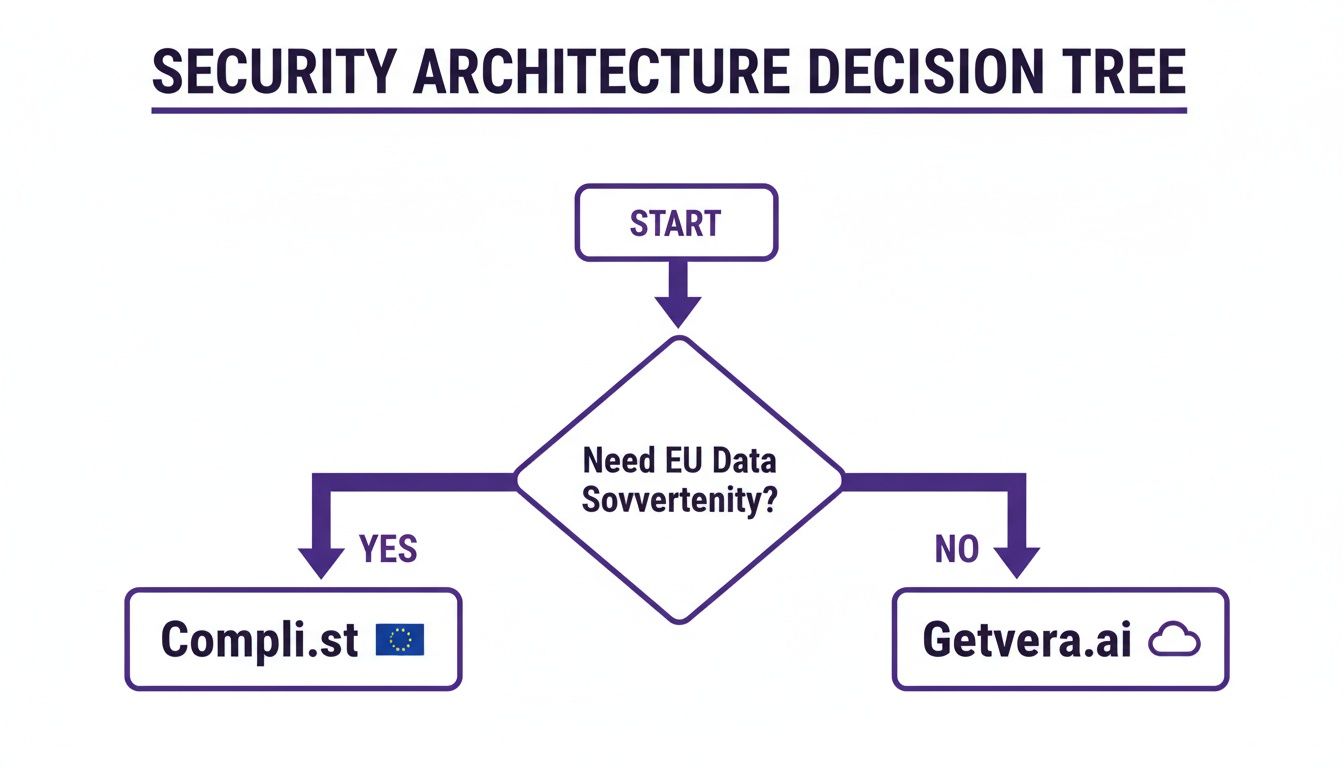
For any business needing to meet strict EU data residency requirements for regulations like GDPR, DORA, or NIS 2, the choice is clear. A platform built on a sovereign cloud architecture is the only viable path forward.
Final Decision Framework Checklist
Use this actionable checklist to weigh the factors that matter most to your organization.
- Primary Goal: Is your main pain just response speed, or are you building an auditable compliance programme that also fuels sales?
- Compliance Roadmap: Are certifications like SOC 2, ISO 27001, DORA, or NIS 2 critical for your growth in the next 18 months?
- Data Residency: Do you have customers or operations in the EU that mandate data stay within a sovereign cloud?
- Team Resources: How much time can your security team realistically spend verifying AI-generated answers without creating a new bottleneck?
- Risk Tolerance: What is the business impact of sending a prospect an inaccurate answer to a critical security question?
Answering these questions honestly moves you beyond a feature list to choosing a partner that solves today's problems and scales with you, turning your security programme from a cost centre into a growth engine.
Frequently Asked Questions
When choosing an AI tool for security compliance, many questions arise. Here are direct, practical answers to common concerns when comparing getvera.ai and Compli.st, helping you solve your compliance pain points effectively.
Choosing confidently means understanding the subtle differences in how each platform operates and which one aligns with your company's growth trajectory.
How Do These Tools Ensure Answer Accuracy?
Accuracy is non-negotiable. Sending wrong information can kill a deal and break trust. The platforms approach this challenge differently.
Compli.st uses a strict, audit-first method with its 'Smart Library'. This system requires every AI-generated answer to be tied directly to a verified source document—like an internal policy or a previous audit report. This creates an unbroken chain of evidence.
This approach is designed to prevent AI 'hallucinations,' where the model invents answers. If the information isn't in your verified library, an answer won't be generated. This enforces a discipline that is invaluable when an auditor or enterprise prospect is scrutinizing your security.
Other platforms may use more general AI models, pulling answers from a large pool of data. While this can create a first draft faster, it shifts the burden to your team to manually check every response for accuracy, introducing risk and a new manual bottleneck.
Can These Tools Help Achieve ISO 27001 or SOC 2?
Yes, but their roles are vastly different. It comes down to whether a tool is a simple response machine or a complete compliance management system.
Some tools are built almost exclusively to automate security questionnaires. They help sales move faster but don’t provide the foundational framework management needed to pass a full audit for frameworks like ISO 27001, SOC 2, DORA, or NIS 2.
On the other hand, platforms like Compli.st are designed as all-in-one GRC (Governance, Risk, and Compliance) solutions. They come with specific modules built for the heavy lifting of compliance:
- Risk Assessment: Tools to run formal risk analyses aligned with standards like ISO 27005.
- Policy Management: A central hub to create, approve, and maintain all security policies.
- Evidence Collection: A system to link your security controls directly to the proof that they’re effective.
This makes them a far more robust partner for preparing for and passing audits, turning compliance efforts into reusable assets for sales.
What Is Data Sovereignty and Why Does It Matter?
Data sovereignty is the principle that your data is governed by the laws of the country where it’s physically stored. This is not technical jargon; for many businesses, it’s a non-negotiable legal requirement and a major pain point.
If your company operates in the EU or handles data from EU citizens, regulations like GDPR have strict rules about data location and processing. New frameworks like DORA for finance and NIS 2 for critical infrastructure are making these rules even stricter.
That’s why choosing a compliance tool hosted on sovereign clouds—on servers physically located within EU data centres—is critical. It's one of the first questions a savvy European prospect will ask. Using a platform that cannot guarantee your data stays within a specific region creates a major compliance risk that can block deals and expose you to fines.
Ready to stop wasting engineering time on questionnaires and start building an audit-ready compliance programme? Compli.st turns your security posture into a sales accelerator. Book a demo today and see how you can complete your next questionnaire in minutes, not days.