A Business Impact Analysis, or BIA, is the process you go through to figure out what would happen if your business suddenly hit a major snag. Think of it as the groundwork for building a truly resilient organization. For a startup or SMB, it cuts through the noise to show you exactly which parts of your operation are absolutely essential and how fast they need to be back up and running to prevent serious damage, especially when facing compliance audits for frameworks like ISO 27001 or SOC 2.
Why a Business Impact Analysis Is Your Resilience Blueprint
Let's be honest, in today's world, disruptions aren't a matter of if, but when. For small and medium-sized businesses (SMBs), a single unexpected event—a ransomware attack, a key SaaS provider outage, or a critical supplier going bust—can be the tipping point between thriving and shutting down. This is why a Business Impact Analysis isn't just another box-ticking exercise for a compliance audit; it’s a core survival tool that helps you answer security questionnaires with confidence.
I like to think of a BIA as an MRI for your company. It gives you a detailed scan of your entire operation, highlighting the critical functions that keep the lights on and the revenue flowing. Without this deep-seated knowledge, you’re flying blind, unable to tell the difference between a minor hiccup and a full-blown catastrophe until it's too late. The BIA provides the hard data you need to build solid business continuity and disaster recovery plans that auditors and enterprise customers expect to see.
Building a Foundation for Resilience
A well-executed BIA brings incredible clarity, turning vague, abstract risks into concrete, manageable problems. The main benefits for an SMB really come down to:
- Protecting Your Revenue: Once you know which processes bring in the most money, you can make sure they’re the first to be recovered, keeping financial losses to a minimum during a crisis.
- Maintaining Client Trust: Failing to meet SLAs due to an outage can kill a startup's reputation. A solid BIA and continuity plan shows customers you can keep services running, which is critical for loyalty and avoiding contract penalties.
- Smarter Resource Allocation: A BIA shows you exactly where to focus your limited time and money. You can invest in protecting the assets and functions that truly matter, instead of wasting resources on less critical areas.
Skipping this step can have some pretty dire consequences. In 2023, France saw a shocking 56,601 business failures, which is an 8% jump from the pre-pandemic levels of 2019. Many of these failures happened because the businesses simply couldn't weather the storm of a major disruption—a weakness a BIA is specifically designed to uncover and fix.
A BIA forces you to answer a critical question: "If everything went down, what would we need to bring back online first to survive?" The answer to that question is the starting point for your entire resilience strategy.
At the end of the day, this analysis gives you the essential data for your whole continuity strategy. It’s important to understand the fundamental difference between business continuity vs disaster recovery, and the BIA is what connects the dots between identifying potential impacts and creating real, actionable recovery plans. It also plugs directly into your wider cybersecurity strategy, a topic we cover in our guide on risk analysis and management. This is about much more than just satisfying an ISO 27001, SOC 2, or DORA requirement; it’s about building a business that can take a punch and keep moving forward.
A Step-by-Step Guide to the BIA Process
Let’s be honest, the idea of conducting a Business Impact Analysis can feel overwhelming, particularly if you’re running a lean team at a startup or SMB. But it doesn't have to be a monumental undertaking. The secret is to treat it not as one giant project, but as a series of clear, manageable steps.
When you approach it systematically, each phase naturally builds on the one before it. This is how you methodically uncover hidden dependencies, really understand what’s at stake, and ultimately build a more resilient organisation that can satisfy auditors and enterprise clients.
Think of the BIA journey as three distinct stages: first you reveal the vulnerabilities, then you analyse them, and finally, you put protections in place.
Step 1: Initiate and Define the Scope
Before you even think about collecting data, you need to set some clear boundaries. One of the classic mistakes is trying to boil the ocean—analysing every single process across the entire business at once. This is a surefire recipe for burnout and a muddled, unfocused result.
Instead, your first move is to get leadership on board. With their backing, you can define exactly what the BIA will cover and, just as importantly, what it won’t. This scope should clearly outline the specific departments, business units, or critical services you’re putting under the microscope. This initial groundwork sets the stage for the whole project, making sure everyone knows what the goals are and what’s expected of them.
For a SaaS startup, for instance, a smart approach would be to focus first on core product delivery and customer support—the absolute lifeblood of the business—rather than getting bogged down in internal HR or marketing operations. This targeted strategy gets you to actionable insights much faster.
Step 2: Gather the Information
Once your scope is locked in, it’s time to start digging. This is the fact-finding phase where you get a real-world understanding of how your organisation actually ticks. The objective is to gather detailed information on key business processes, identify all the resources they lean on, and start mapping out the potential consequences if they were to fail.
This is not a solo mission. Getting this right means talking to the right people from across the company. A blended approach usually works best:
- Targeted Questionnaires: Send detailed questionnaires to department heads and the people who own specific processes. Ask pointed questions about their team’s most critical functions, the technology and people they need, and any dependencies they have on other teams or third-party suppliers.
- Stakeholder Interviews: There’s no substitute for a real conversation. Sit down with key personnel, from the finance managers who understand the revenue flows to the system administrators who know the IT infrastructure inside and out. These one-on-one interviews often uncover the crucial details and nuances that a form will always miss.
Remember, the quality of your BIA is a direct reflection of the quality of the information you gather at this stage. Be thorough, ask follow-up questions, and don’t stop until you have the full picture.
Step 3: Analyse the Data
With all the raw information collected, the real analysis begins. This is where you connect the dots, sifting through interview notes and survey responses to identify patterns, dependencies, and ultimately, your most essential business functions. You're trying to quantify the impact of a disruption over time.
This means asking tough questions. What's the daily revenue loss if our e-commerce platform goes dark? What are the regulatory fines we’d face for missing a service-level agreement? This analysis transforms your data from a simple list of activities into a strategic understanding of risk.
This analytical process is what separates a BIA from a simple inventory of business functions. It's about understanding the ripple effect of a single failure across the entire organisation.
Step 4: Generate the Report and Recommendations
The final step is to translate your findings into a clear, concise report for the decision-makers. This document needs to do more than just present facts and figures; it must tell a compelling story about the organisation’s vulnerabilities and offer clear, actionable recommendations.
Your report should summarise the BIA's key takeaways, including a prioritised list of critical business processes and their associated recovery metrics (like RTOs and RPOs, which we’ll cover next).
This document is the cornerstone of your business continuity and disaster recovery plans. It provides the hard evidence needed to justify investments in resilience, helping leadership allocate budget and resources to protect what truly matters most.
RTO, RPO, and MTD: The Language of Business Resilience
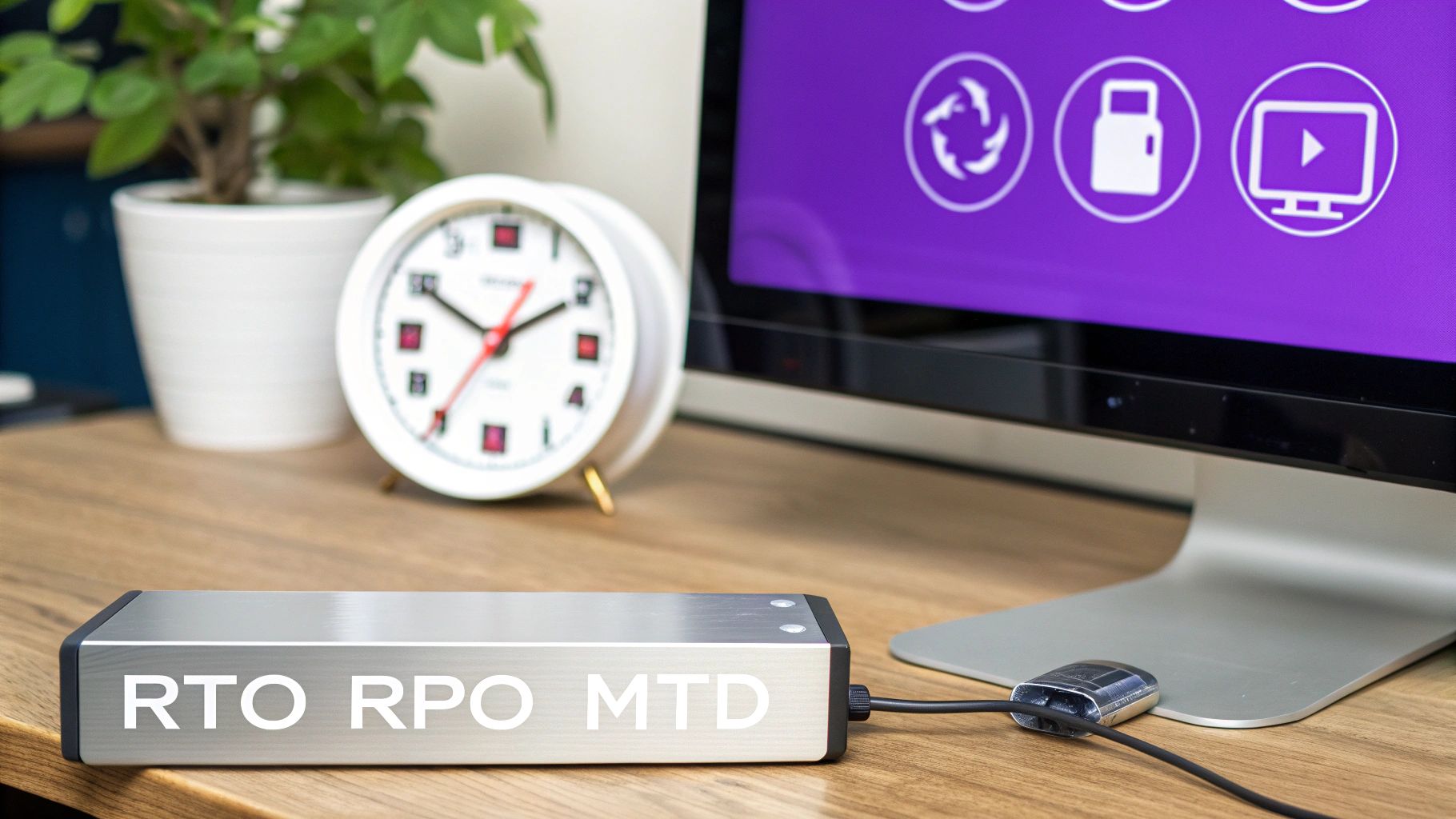
Once your BIA has pinpointed what’s truly critical to your operations, the real work begins. It's time to translate those findings into hard numbers that will anchor your entire continuity strategy. This isn’t about guesswork; it's about assigning precise, quantifiable metrics to each critical process.
These metrics—RTO, RPO, and MTD—are the language of resilience. They turn abstract risks into concrete operational targets. These aren’t just technical terms, either. They are fundamental business decisions that dictate your budget, your technology stack, and your promise to customers when things go wrong. For any growing business, getting these numbers right is the key to building a recovery plan that’s both effective and financially sound.
Understanding Your Recovery Point Objective (RPO)
The Recovery Point Objective (RPO) answers a deceptively simple question: "How much data can we stand to lose?" It’s the maximum acceptable age of the data you need to recover to get back on your feet.
Think of it like hitting the ‘save’ button while working on an important document. If you save every five minutes, your RPO is five minutes; you risk losing, at most, a few minutes of work. If you only save at the end of the day, your RPO is 24 hours, and a sudden system crash would be far more painful.
For a SaaS company, the customer database might have an RPO of mere seconds, because losing even a few minutes of transaction data could be catastrophic. In contrast, an internal marketing analytics platform might have an RPO of 24 hours, as a day's worth of lost data would be inconvenient but not fatal.
Defining Your Recovery Time Objective (RTO)
While RPO is all about data, the Recovery Time Objective (RTO) is all about downtime. It tackles the question: "How quickly do we need this back online?" The RTO is the target time you set for restoring a critical function after a disruption hits. It's the ticking clock that drives your recovery efforts.
This single metric dictates the urgency and, by extension, the cost of your recovery solutions. A very short RTO—say, under 15 minutes for your primary customer-facing application—will require sophisticated, often expensive, automated failover systems. A longer RTO, like 24 hours for an internal HR portal, gives you the breathing room to use more manual, cost-effective recovery methods.
If you want to dig deeper into this specific metric, our detailed guide on the Recovery Time Objective is a great place to start.
Setting the Maximum Tolerable Downtime (MTD)
The Maximum Tolerable Downtime (MTD) is the absolute line in the sand. It defines the point at which a disruption causes irreparable harm to the business—we're talking about catastrophic financial loss, irreversible brand damage, or major regulatory penalties. It’s the moment an incident becomes an existential threat.
The MTD is your ultimate deadline, and it should always be longer than your RTO. Think of it this way: the RTO is your goal, while the MTD is the point of no return. That gap between your RTO and MTD is a critical buffer zone. It gives your team time to manage the incident, troubleshoot unexpected problems, and execute the recovery plan without pushing the business over a cliff.
Understanding Key BIA Recovery Metrics
To put it all together, these three metrics work in concert to define your resilience posture. This table breaks down how they differ and why each one matters.
| Metric | What It Answers | Business Implication | SaaS Example |
|---|---|---|---|
| RPO | "How much data can we afford to lose?" | Determines the frequency of backups and data replication needed. | A CRM platform needs an RPO of 5 minutes to avoid losing critical sales activity. |
| RTO | "How fast must this system be restored?" | Drives the choice of recovery technology and procedures (e.g., hot vs. cold sites). | The core application login service must have an RTO of 15 minutes to prevent customer churn. |
| MTD | "At what point is the business permanently harmed?" | Sets the absolute final deadline for recovery, defining the ultimate business risk. | The entire platform's MTD might be 4 hours before major clients begin terminating contracts. |
Getting a firm grasp on these concepts is the most crucial output of a BIA. They provide the clear, data-driven guardrails needed to design a resilience strategy that actually fits your operational reality and budget. These figures are also essential evidence for compliance frameworks like DORA, SOC 2, and ISO 27001, proving to auditors that your continuity planning is built on a solid foundation.
Turning BIA Insights Into Actionable Continuity Plans
A business impact analysis (BIA) that just sits on a shelf is pointless. Its real worth comes to light when you translate its findings into a concrete, actionable resilience strategy. For many smaller businesses, this is often where the process stalls; the gap between knowing your vulnerabilities and knowing what to do about them can seem huge.
The insights from your BIA are the essential ingredients for your broader risk assessment and your Business Continuity Plan (BCP). They provide the objective data needed to shift from a reactive to a proactive security posture.
Connecting BIA to Your Risk Assessment
Think of it this way: your BIA identifies what is critical, while a risk assessment identifies the threats that could disrupt those critical functions. The two processes work hand-in-hand.
For example, knowing your customer payment portal has an RTO of just one hour allows you to prioritise the risks that could take it offline—like a DDoS attack, a database failure, or a specific software vulnerability. This linkage ensures you focus your resources where they’ll deliver the most protection. Instead of trying to mitigate every conceivable risk, you can concentrate on shielding the processes most vital to your survival.
Your BIA is the roadmap that tells your risk assessment where to look. It prevents you from wasting time and money on low-impact threats while leaving your crown jewels exposed.
The BIA’s outputs—your list of critical processes, RTOs, and RPOs—become the lens through which you view your entire risk landscape. This ensures every security decision is tied directly to a tangible business outcome.
Building Your Business Continuity Plan
A Business Continuity Plan is the detailed playbook your organisation follows during and after a disaster. Your BIA provides the foundational strategy for this plan. After all, you can't create recovery procedures until you know what needs recovering and in what order.
Here’s how BIA findings directly shape your BCP:
- Prioritised Recovery Steps: The RTOs and MTDs you’ve defined dictate the sequence of recovery efforts, ensuring the most time-sensitive functions are restored first.
- Resource Allocation: Your BIA highlights the specific technology, people, and third-party services needed to bring critical processes back online.
- Strategy Development: Based on RTOs, you can decide on the right recovery strategy. A one-hour RTO, for instance, might necessitate an expensive hot site, whereas a 48-hour RTO could be met with a more affordable cold site.
Once you’ve deconstructed the BIA process and decoded its key metrics, the insights are instrumental for developing robust strategies, including a Practical Guide to Security Incident Response Planning. To dig deeper into this, our article on how to plan for recovery provides excellent context.
A Strategic Advantage for Compliance
This direct link between analysis and action is precisely what auditors for frameworks like ISO 27001, SOC 2, and DORA want to see. They look for evidence that your security controls and continuity plans aren’t arbitrary but are based on a documented understanding of business impact. A robust BIA demonstrates a mature, risk-aware security programme.
This is especially critical in growing economies. France, for example, attracted 1,815 international investment decisions in 2023, creating thousands of jobs. With many of these investments in smaller municipalities, a business impact analysis is essential to safeguard this growth by ensuring business continuity and protecting these job-creating inflows.
Ultimately, a well-executed BIA turns a compliance requirement into a powerful strategic advantage, proving to customers and stakeholders that your business is truly built to last.
Common BIA Mistakes and How to Avoid Them
A business impact analysis is a fantastic tool, but its value hinges entirely on how you use it. Even with the best intentions, a few common stumbles can derail the whole project, turning a strategic exercise into a frustrating drain on time and resources. Knowing what can go wrong is the first step to getting it right.
Successfully running a BIA means watching out for the subtle traps that can poison your results from day one. These mistakes often lead to flawed data, a lack of buy-in, and a continuity plan that simply won't work when you need it most.
Mistake 1: Poor Scoping
One of the most common blunders is trying to analyse everything all at once. This "boil the ocean" approach is a fast track to overwhelming complexity and a burnt-out team. When a BIA has no clear boundaries, it loses focus, and the final report ends up a diluted mess of data with no clear priorities.
The fix? Start small and be specific. Scope your first BIA to a single critical service or a specific business unit. If you're a SaaS company, you might focus only on your core application and the customer support functions tied to it. This targeted approach gives you quicker, more actionable insights and builds momentum for tackling other areas later.
Mistake 2: Failing to Secure Executive Buy-In
Without solid backing from leadership, a BIA often gets treated like just another bit of administrative paperwork. Department heads won't make time for interviews, and your recommendations for resilience investments will likely fall on deaf ears. The project will simply lack the authority it needs to make a real difference.
To get leadership on board, you need to speak their language: financial risk, competitive advantage, and customer retention. Show them exactly how understanding critical dependencies protects revenue and fortifies the company's position in the market.
When executives see the BIA as a tool for protecting the bottom line, not just a compliance checkbox, they become its biggest champions. That’s how you get the resources and cooperation you need.
This proactive approach to resilience is especially crucial for growing companies. In 2023, Bpifrance supported nearly 86,520 companies, and those beneficiaries grew their workforce 11.7 points faster than their peers. For scaling businesses like these, a BIA helps prioritise what truly matters, turning financial support into sustainable growth. You can learn more about the impact of strategic resilience on Bpifrance.com.
Mistake 3: Treating the BIA as a One-Off Project
Another critical mistake is thinking of the BIA as a "set it and forget it" task. Businesses are dynamic—processes change, new technologies come online, and dependencies shift constantly. A BIA from two years ago might be dangerously irrelevant today.
The key is to weave the BIA into your operational rhythm. Schedule regular reviews, at least once a year, or whenever there's a significant business change like a new product launch or a major system migration. This transforms the BIA from a dusty document on a shelf into a living guide that reflects your current reality and keeps your continuity plans sharp and effective.
How Modern Compliance Tools Can Transform Your BIA
Let’s be honest: running a proper business impact analysis (BIA) using the old-school spreadsheet method is a real headache. For smaller businesses and start-ups, the process of chasing down department heads, trying to make sense of inconsistent data, and keeping everything up-to-date is a massive time sink. It’s slow, tedious, and often riddled with errors.
This is where modern compliance platforms can really make a difference. They take the BIA from a painful, manual exercise and turn it into a living, strategic part of your security programme. Instead of a mess of scattered documents, you get a single, central place for everything related to your BIA.
Think about it: with a dedicated platform, you can send out standardised questionnaires to every department, ensuring you get the information you need in a consistent format. Right away, you’ve saved yourself countless hours of admin work and avoided the usual gaps that pop up when doing things by hand.
Centralise Your Documentation for Audits and Sales
One of the biggest hurdles for any growing company is proving its resilience to auditors or big-name customers. Frameworks like ISO 27001, SOC 2, DORA, and NIS 2 demand solid proof that your business continuity plans are built on a thoughtful BIA. Trying to pull this evidence together manually, often at the last minute, means frantically digging through old emails and shared drives. It’s not a good look.
Modern compliance tools fix this by automatically connecting your BIA findings to your risk assessments and continuity plans. This creates a clean, clear audit trail that shows you have a mature, well-thought-out security programme. For example, platforms like Compli.st provide a central hub where all this documentation lives, organised and ready to go.
This is what a modern compliance dashboard can look like, providing a clear overview of your security posture.
Having everything in one place—from risk analysis to policy documents—makes preparing for an audit so much simpler.
This level of organisation also pays off massively during the sales cycle. When a promising new client sends over their lengthy security questionnaire, you can respond with speed and confidence. Instead of a last-minute scramble, you can simply pull the BIA-related evidence straight from the platform and show them you’re a professional, trustworthy partner.
Turn Compliance Into a Competitive Advantage
Using a modern tool for your BIA isn't just about saving time; it’s about turning a compliance checkbox into a tool that helps you win business. A well-managed BIA process allows you to:
- Answer Security Questionnaires Faster: With all your data in one place, you can pull up answers about your RTOs, RPOs, and continuity plans in minutes, not days.
- Demonstrate a Mature Security Posture: A professionally documented BIA, managed within a compliance platform, tells potential clients you take the security of their data and your service availability seriously.
- Help Sales Close Bigger Deals: When you can quickly and easily meet the security demands of enterprise clients, you remove one of the biggest roadblocks in the sales process. This empowers your sales team to land larger, more valuable contracts.
Ultimately, by ditching the spreadsheets, you free up your team to work on what really matters—growing the business. Your BIA stops being a static document filed away somewhere and becomes what it’s supposed to be: a strategic guide for building a more resilient and profitable company.
Common Questions About Business Impact Analysis
Let's finish up by tackling some of the questions that almost always come up when businesses first get their hands dirty with a business impact analysis (BIA). These are the practical, real-world queries we hear all the time.
How Often Should We Actually Do This?
A BIA isn't a one-and-done checkbox exercise. Think of it as a living document that needs to keep pace with your business.
A full, formal review at least once a year is a solid baseline. But you'll also want to revisit it anytime something significant changes in the business. This could be launching a new product, moving a core system to a new provider, or even a major team restructure. The goal is to make sure your continuity plans aren't based on an outdated snapshot of how you operate.
Isn't a BIA Just Another Name for a Risk Assessment?
This is a classic point of confusion, but they are two sides of the same coin—distinct but deeply connected.
- A Business Impact Analysis (BIA) is all about the aftermath. It answers the question, "If this process suddenly stops, how badly does it hurt us, and how quickly?"
- A Risk Assessment looks at the causes. It asks, "What things—like a power outage, a cyberattack, or a supplier failure—could actually make that process stop?"
Put simply, the BIA tells you which parts of your business are most critical to save first. The risk assessment then tells you what threats you need to protect them from. They work together.
Who Needs to Be in the Room for This?
A BIA done in a silo is a BIA destined to fail. To get this right, you need a mix of perspectives from across the business. It’s a team sport, not a solo IT project.
You’ll want to pull in people like:
- Executive Leadership: They provide the high-level vision and ensure the whole company takes it seriously.
- Department Heads: These are your subject matter experts. They know exactly what their teams do, what they rely on, and what breaks if they go offline.
- IT and System Owners: They bring the technical context, explaining how the applications and infrastructure actually support everything.
- Finance and Legal Teams: They are crucial for helping to put real numbers on financial impacts and flagging any compliance or contractual deadlines you can't afford to miss.
Bringing this group together turns the BIA from a simple checklist into a strategic conversation. You uncover hidden dependencies and get a true, 360-degree view of your operations, which is where the real value lies.
By involving the right people and making the BIA a regular part of how you operate, it becomes a powerful tool for building genuine resilience.
A solid BIA is the bedrock of any serious security and resilience programme. Compli.st is built to make this process less painful, helping you move from insight to action quickly. Our platform helps you centralise your documentation, link your BIA directly to risk assessments, and makes gathering evidence for audits like ISO 27001 and SOC 2 much simpler. This lets you build a more resilient business and close deals with confidence. See how we can help at https://www.compli.st.