A due diligence questionnaire, or DDQ, is a formal set of questions a potential enterprise client sends to vet your company's health—operationally, financially, and especially when it comes to security. For any startup or SMB, responding to a DDQ has become a make-or-break moment in the sales process. It’s a direct test of your security posture and your operational maturity. Failing to answer efficiently and accurately doesn't just slow down a deal; it kills it.
Why Your Business Cannot Afford to Ignore Due Diligence
Don't think of a DDQ as just another form to fill out. See it for what it is: a crucial, trust-building conversation that happens right before a major partnership is signed. It’s how a potential customer performs a deep-dive ‘business health check’ on you, making absolutely sure you’re a safe and reliable partner. A poorly handled DDQ can stop a promising deal dead in its tracks, becoming a major sales bottleneck. The pain is real: your sales team is blocked, and your engineers are pulled away from product development to answer the same security questions over and over again.
On the flip side, a masterful and efficient response builds instant confidence and can seriously accelerate the sales cycle. This isn't some rare task anymore; it's a core business function. The frequency and depth of these questionnaires are only increasing, largely driven by a global push for much stronger supply chain security.
The Growing Pressure from Regulations
Regulations like NIS 2 and DORA are forcing large enterprises to meticulously vet their entire supply chain, and that includes every SaaS vendor and tech partner they work with. This regulatory pressure cascades downstream, meaning your startup is now expected to prove its security posture with clear, documented evidence from frameworks like ISO 27001 or SOC 2.
This shift presents both a challenge and a massive opportunity. The challenge is obvious: a disorganized, manual process for answering DDQs drains your team's resources and puts revenue at risk. The pain of digging through old spreadsheets and constantly pinging internal experts for answers is something many growing businesses know all too well.
A due diligence questionnaire is more than a checklist; it's a narrative about your company's reliability. It’s your chance to prove you take security as seriously as your enterprise clients do, turning a compliance burden into a powerful sales tool.
From Required Chore to Competitive Advantage
The real opportunity is in turning this process from a reactive chore into a proactive competitive edge. A swift, accurate, and professional response shows operational maturity and excellence, setting you miles apart from less organized competitors. When you can answer complex security questions quickly and consistently, you send a clear signal to prospective clients: our house is in order. This isn't just about ticking compliance boxes; it's about building the fundamental trust that underpins long-lasting business relationships.
While DDQs might feel similar to other documents in the sales cycle, they serve a very distinct, risk-focused purpose. For a deeper look at how these requests differ, you can find more context on the pre-sales process in our guide on RFIs and RFPs.
Ultimately, getting your due diligence process right allows your team to:
- Accelerate Sales Cycles: Slash the time your deals spend stuck in security reviews.
- Build Client Confidence: Showcase a strong, organized security posture from the very first interaction.
- Mitigate Deal Risk: Avoid the common red flags that make enterprise buyers nervous and walk away.
- Free Up Technical Teams: Let your engineers and security experts get back to their core work instead of answering the same questions over and over.
By truly understanding the 'why' behind these questionnaires, you can start building a repeatable system that not only meets requirements but actively helps you close more deals, faster.
Breaking Down the Key Sections of a Questionnaire
A due diligence questionnaire can look like a mountain of highly technical questions. But once you understand its anatomy, it stops being a checklist and starts being a strategic conversation. Every section is there to probe a specific area of your business’s security and operational health, giving you a chance to prove your maturity and earn their trust.
Think of it less as an interrogation and more like a guided tour of your security program. When a potential partner asks these questions, they aren't just hunting for a "yes" or "no" answer. They're sizing up the strength of your controls and the thinking behind your approach. Let's pull apart the core components you'll almost certainly find inside.
Information Security and Governance
This is the bedrock of any security-focused questionnaire. The questions here get to the heart of your overarching security strategy and the formal policies that steer your organization. It’s where you show that your security measures are deliberate, documented, and have backing from the top.
You’ll typically see questions like:
- "Do you have a formally documented set of information security policies, and how often are they reviewed?" This checks if your security is just a casual practice or a solid, approved framework.
- "Who is responsible for information security within your organization (e.g., CISO, Security Manager)?" They want to confirm there's clear ownership and accountability for your security program.
- "Can you provide a copy of your Information Security Policy?" A straightforward request to see your main governing document.
Access Control and Identity Management
This section is all about who can access what data and how. For any SaaS company, this is absolutely critical. Clients need to know their sensitive information is locked down from both internal and external threats. The focus is squarely on the principle of least privilege—making sure people only have access to what they truly need to do their job.
Expect questions such as:
- "Describe your user access review process. How frequently are access rights audited?"
- "What are your password complexity and rotation requirements?"
- "Do you enforce Multi-Factor Authentication (MFA) for access to critical systems and data?"
A strong set of answers here proves you run a tight ship, which is a massive confidence-booster for any enterprise client.
Incident Response and Business Continuity
Let's face it, no system is completely bulletproof. This part of the DDQ assesses how you'd react when something inevitably goes wrong. Prospective partners need to see that you can spot, respond to, and recover from a security incident with minimal disruption to their service.
A well-documented incident response plan is one of the most powerful assets you can present in a DDQ. It shows you've moved beyond prevention and have a mature plan for resilience, demonstrating foresight and preparedness.
Common questions you'll encounter are:
- "Describe your process for detecting, reporting, and responding to a data breach."
- "Do you have a formal Business Continuity Plan (BCP) and Disaster Recovery (DR) plan?"
- "When was your incident response plan last tested?"
Data Privacy and Protection
With regulations like GDPR and CCPA now firmly in place, data privacy isn't optional. This section zeroes in on how you handle personal and sensitive data from collection to deletion. It’s your chance to demonstrate real compliance and respect for user privacy—a crucial selling point. For a deeper look, check out our guide on the importance of a Data Processing Addendum and data protection.
Be ready to answer questions like:
- "How do you ensure compliance with relevant data protection regulations like GDPR?"
- "Describe the technical and organizational measures you use to protect personal data."
- "What is your process for handling data subject access requests (DSARs)?"
While these sections are security-centric, this structured approach applies to other business areas, too. For example, an HR Due Diligence Checklist applies the same rigorous Q&A format to evaluate a company's human resources practices.
How Global Regulations Shape Your Questionnaire
A due diligence questionnaire isn't just a simple back-and-forth between you and a potential customer. It's often a direct reflection of a complex web of global regulations that create powerful ripple effects. A law passed in one country can completely change the questions a company on the other side of the world has to ask its suppliers—including your startup.
This is because large enterprises are now legally required to police their entire supply chain. They aren't just being nosy about your security program; they have a legal obligation to verify it. For a startup, this raises the stakes considerably. Your ability to provide clear, confident, and verifiable answers is no longer a "nice-to-have." It's a deal-breaker.
A Case Study: The French Duty of Vigilance Law
A perfect example of this is France's pioneering Duty of Vigilance Law. Enacted on 27 March 2017, this law requires large French companies to create and implement detailed vigilance plans. These plans are designed to identify and prevent serious risks related to human rights, health, safety, and the environment—not just within their own walls, but throughout their entire network of suppliers and subcontractors.
So, what does a law in France have to do with your SaaS startup based somewhere else? Everything. If your prospect is a large French enterprise, you are officially part of their supply chain. That means they are legally bound to scrutinize your operations, and the DDQ is their primary tool for doing it.
This isn't an isolated French quirk. It’s a blueprint for regulations that are now appearing across the European Union and beyond.
From Regional Laws to Global Standards
This model of cascading responsibility is fast becoming the global standard. Regulations like the EU's NIS 2 and DORA directives apply similar pressure, compelling entire industries to get serious about their third-party risk management. The underlying principle is simple: big companies are now on the hook for the compliance and security of their vendors.
This creates a direct line from a parliamentary decision in one country to the questionnaire that lands in your inbox. The questions you’re being asked about data protection, incident response plans, and security governance are often lifted straight from these legal mandates.
The modern due diligence questionnaire is not just a best practice; it's a mechanism for regulatory enforcement. Your answers serve as legal evidence that your client has fulfilled their own due diligence duties, making your responses a critical part of their compliance framework.
This is precisely why having internationally recognized certifications is such a game-changer. They serve as a universal language of trust.
Why Certifications Like ISO 27001 And SOC 2 Matter More Than Ever
In this high-stakes environment, certifications like ISO 27001 and SOC 2 are no longer just optional extras. They're becoming essential for market access and are one of the best ways to get through the DDQ process without losing your mind. Presenting a valid certification allows you to proactively answer dozens, if not hundreds, of questions in one fell swoop.
- It Builds Immediate Trust: A certification is an independent, third-party validation of your security program. It offers a level of assurance that simply saying "trust us" never will.
- It Demonstrates Maturity: It proves you've invested in building a robust, auditable security framework. This signals to enterprise clients that you're a serious, reliable partner.
- It Accelerates Sales Cycles: Instead of getting bogged down answering granular questions one by one, you can simply point to your certification report as evidence of your controls. This can shave weeks off a security review.
For regulations like GDPR, which demand strict data protection measures, having a structured compliance program is non-negotiable. Maintaining detailed records of processing activities is a core requirement, and it's a task that becomes much simpler with the right tools and processes. To get a better handle on this, check out our guide on how to use a GDPR register generator.
Ultimately, the growing regulatory landscape means that proving your security and compliance is no longer optional. Having a system to manage your security posture and a clear way to demonstrate it—through certifications and well-organized DDQ responses—is fundamental to competing for and winning enterprise deals.
Building Your Repeatable DDQ Response Workflow
Responding to a due diligence questionnaire shouldn't feel like a last-minute fire drill. But for fast-growing businesses, that’s often exactly what it is. An ad-hoc approach quickly becomes a major bottleneck, draining your team’s energy and stalling promising deals. The key to escaping this chaos is to stop reacting and start building a proactive, repeatable workflow.
Creating a structured system transforms the DDQ from a source of friction into a smooth, efficient part of your sales motion. It shows you’re organized and professional, building trust with potential clients from the very first interaction. Let’s walk through how to build that playbook, step by step.
Step 1: Centralize Every Incoming Request
The first breakdown in any manual process happens when requests fly in from all directions—a salesperson’s inbox, a support ticket, a direct email to the CEO. This chaos leads to confusion over who owns what, and inevitably, things get dropped. The fix is surprisingly simple: create a single, dedicated channel for all incoming security questionnaires.
This could be a specific email alias (like security-reviews@yourcompany.com) or a dedicated channel in your team's communication tool. The goal is straightforward: make sure every DDQ lands in one place where it can be logged, assigned, and tracked. This first step brings immediate visibility and establishes clear accountability right from the start.
Step 2: Assemble Your Go-To Response Team
Answering a DDQ is rarely a one-person job. It demands input from across the business to ensure the answers are not just accurate, but also aligned with your commercial goals. Take the time to define your core response team with clear roles.
- Sales/Account Executive: This person is the project manager. They own the client relationship and are responsible for keeping the process moving forward.
- Security/Compliance Lead: Your subject matter expert. They are responsible for the technical accuracy of every security and compliance-related answer.
- Legal Counsel: The final reviewer for any questions touching on contracts, liability, data privacy, and regulatory commitments.
This cross-functional team ensures all your bases are covered, from technical controls to legal obligations, so you can present a unified and professional front.
This diagram shows how regulatory requirements flow down from governing bodies to enterprises, who then pass those same due diligence obligations onto their suppliers.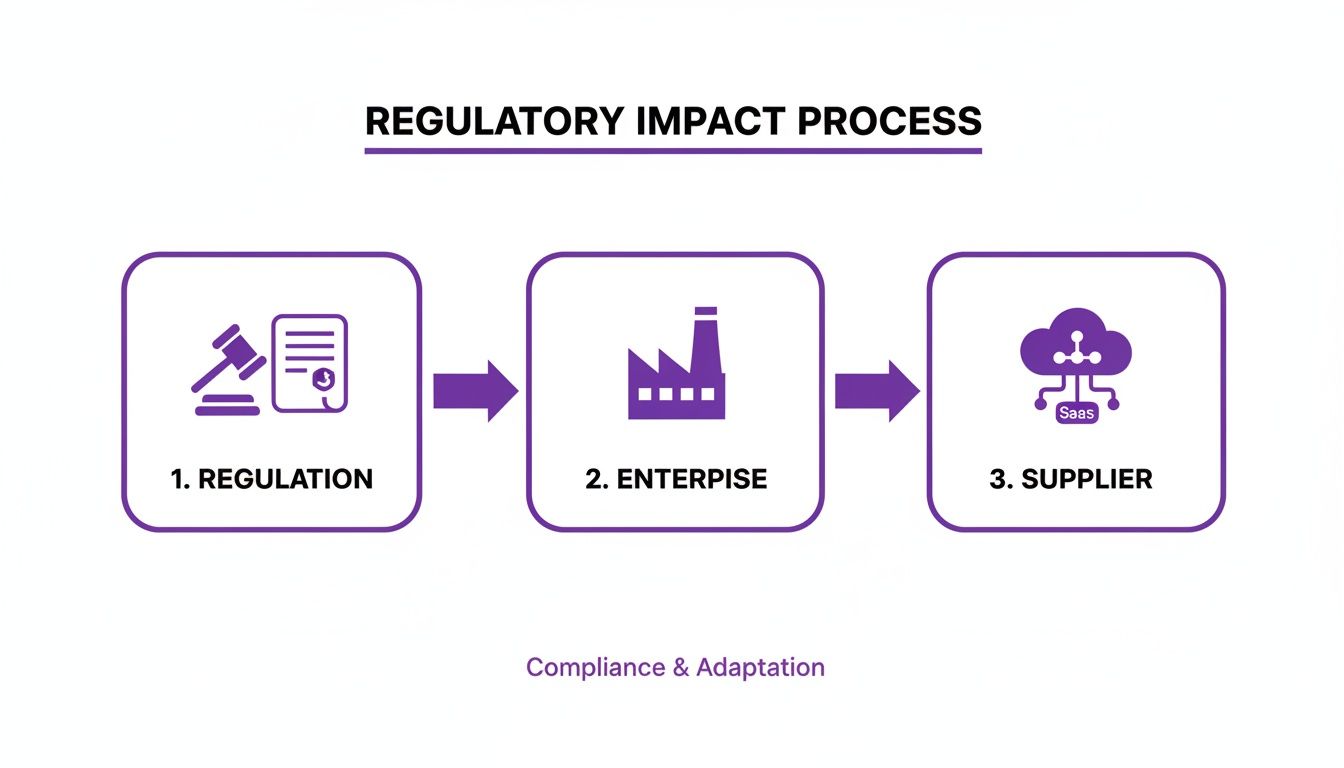
The visualization makes it clear that your company's response to a DDQ is a direct result of your client's need to satisfy their own legal and regulatory duties.
Step 3: Build Your Single Source of Truth
The most time-consuming part of any DDQ response is hunting for information. Your security policies, audit reports, previous answers, and technical documents are probably scattered across different drives, platforms, and people’s heads. This is where a centralized knowledge base becomes a true game-changer.
Think of this "single source of truth" as a library for all your approved security and compliance information. Modern compliance platforms like Compli.st can act as an AI-powered answer library, ingesting all your existing policies and documents. When a new question comes in, the system can instantly generate a precise, source-cited response, ensuring every answer is fast, consistent, and accurate.
By creating a single, reliable repository for all compliance-related knowledge, you eliminate the guesswork and inconsistency that plague manual DDQ processes. This repository is the engine of a scalable and efficient response workflow.
Step 4: Implement a Streamlined Review Process
Once you've drafted the answers, the questionnaire needs a final review before it goes back to the client. Define a clear, simple workflow for this. The security lead should validate technical accuracy, while the sales owner ensures the tone and language are client-friendly and on-message.
This step is your last line of defence against sending inconsistent or outdated information. The stakes can be high. In France, for example, third-party due diligence is a critical part of anti-corruption programs under the Agence Française Anticorruption (AFA). Their guidelines demand risk-based assessments to reduce bribery exposure, with the most comprehensive scrutiny reserved for high-risk third parties. Sending inaccurate information in that context could have serious consequences. You can discover more insights about these French AFA guidelines on their official site.
Step 5: Define Your Follow-Up Strategy
Your work isn’t done when you hit "send." Establish a clear process for what happens next. The sales lead should confirm receipt with the client and be prepared to jump on any follow-up questions quickly.
This kind of proactive communication reinforces your professionalism and keeps the deal’s momentum going. It turns a potential hurdle into just another positive touchpoint in the sales cycle.
How to Automate Your Questionnaire Responses
For most startups and small to medium-sized businesses, the manual DDQ process is a genuine nightmare. It's a frantic scramble through shared drives, old spreadsheets, and endless Slack messages, all while a high-value deal hangs in the balance. This reactive, inefficient cycle doesn't just drain your resources; it actively stalls sales and erodes client confidence.
To grow, you have to move beyond these manual methods. The real objective is to transform this burden into a strategic advantage by automating how you respond. This shift lets your team stop chasing down information and start closing deals faster.
The Power of an AI-Powered Knowledge Library
Imagine having a system that acts as your company's collective security memory. This isn't just another passive folder for storing documents. An AI-powered compliance platform becomes a dynamic knowledge library, ingesting your key security documents—policies, procedures, past questionnaires, and audit reports like your SOC 2—to create a single, reliable source of truth.
When a new DDQ lands in your inbox, the system doesn't just search for keywords; it understands the context of the question. It can generate precise, accurate, and source-cited answers in minutes, not weeks. This capability is a total game-changer, wiping out the risk of sending outdated information you copied from an old spreadsheet.
Automation turns your questionnaire response process from a defensive chore into a proactive sales enablement function. It empowers your team to deliver high-quality, verifiable answers at the speed your business requires to win.
This approach is becoming absolutely critical as regulatory scrutiny gets tighter. France, for example, has been a leader in enforcing corporate sustainability with its 2017 Duty of Vigilance Law, which has influenced broader EU directives. This law forces large firms to create detailed vigilance plans, a requirement that cascades down to their suppliers across the globe. Keeping automated, accurate records is no longer just a good idea; it's indispensable for staying competitive.
Game-Changing Features That Accelerate Sales
Modern automation tools are designed to solve the most painful parts of the questionnaire grind. They go far beyond simple answer storage, offering tangible benefits that directly boost your bottom line. For businesses wanting to simplify these complex workflows, using a no-code automation platform can dramatically improve how you manage and respond to questionnaires.
Here are a few key features to look for:
- Automatic Excel Completion: Many enterprise clients still rely on complicated, multi-tab Excel spreadsheets for their DDQs. The best platforms can populate these forms for you, correctly mapping your approved answers to the right cells. This feature alone can slash the time spent on a single questionnaire by up to 90%.
- Source-Cited Responses: A great system won't just give you an answer; it will link it directly back to the source document, like a specific clause in your Information Security Policy. This gives clients the verifiable proof they need without your team having to do any extra digging.
- Confidence Scoring: Advanced AI will show its confidence level for each answer it generates. It refuses to guess if information is missing, instead flagging questions that need a human expert to review them. This prevents you from ever submitting inaccurate or incomplete data.
Proactively Reducing Questionnaire Volume with a Trust Center
Ultimately, the best-case scenario is to answer fewer questionnaires in the first place. A public-facing Trust Center is an incredibly powerful tool for getting there. Think of it as a centralized, self-service portal where you can proactively share your security and compliance posture with prospects and customers.
A well-organized Trust Center typically includes:
- Certifications and Attestations: Display badges for your SOC 2, ISO 27001, or other audits and provide direct access to the reports.
- Key Security Documents: Share approved versions of your Information Security Policy, privacy notices, and other essential documents.
- Frequently Asked Questions: Get ahead of the game by answering common security questions before anyone even has to ask.
By putting this information out front, you address many of a prospect’s concerns before they even consider sending a full DDQ. This transparency builds immediate confidence, empowers your sales team to move deals forward on their own, and frees up your security experts to focus on what they do best.
Common Questions About Due Diligence Questionnaires
Even with a great workflow, the DDQ process can throw up some tricky, real-world questions. This is especially true if you’re a startup or a growing business trying to navigate the high-stakes world of enterprise sales. Let’s tackle some of the most common concerns that pop up when you’re in the trenches.
How Long Should a DDQ Take to Complete?
For a growing business wrestling with manual methods like spreadsheets and shared docs, finishing a single due diligence questionnaire can take anywhere from a few days to several weeks. This slow-down creates a huge bottleneck in your sales cycle, leaving deals hanging while your team hunts down information from different departments.
That delay is more than just an inconvenience; it can genuinely put a promising deal at risk. Enterprise clients expect momentum, and a sluggish response can signal disorganization.
This is exactly where automation provides a massive competitive edge. By using an AI-powered knowledge library, companies are regularly slashing this response time by up to 90%. A centralized system that automates answers turns a multi-week headache into a task you can often knock out in just a few hours.
What Are the Biggest Red Flags to Avoid?
When an enterprise client is reviewing your DDQ, they're on the lookout for risk. Certain mistakes will immediately raise red flags and can quickly put a deal on shaky ground.
The most common red flags include:
- Inconsistent Answers: If you provide contradictory information across different sections, it’s a major sign of a chaotic and unreliable security program.
- Evasive or Vague Responses: Simply marking a question "N/A" without explaining why or what alternative controls you have is a classic error. It suggests you either don't have a control in place or don't understand the risk behind the question.
- Lack of Evidence: Making claims about your security posture without offering any proof is another critical mistake. Clients expect you to back up your answers with policies, audit reports, or other official documents.
Using a platform that generates source-cited answers directly from your official policies and audit reports is the best way to sidestep these issues. It ensures every response is accurate, consistent, and, most importantly, verifiable.
How to Answer a DDQ Without SOC 2 or ISO 27001
Lacking a formal certification like SOC 2 or ISO 27001 is a common hurdle for early-stage startups. The key is to handle the situation with transparency while clearly demonstrating your progress. Don't just admit you aren't certified; that’s a dead end.
Instead, you need to build a compelling narrative that inspires confidence.
When you don’t have a certification, your goal is to show maturity and commitment. Proactively sharing evidence of your existing security program alongside a clear roadmap for future certification can often satisfy even the most stringent due diligence checks.
Here’s a practical way to approach it:
- Acknowledge the Gap: Be upfront about not having the certification yet.
- Present a Security Roadmap: State your commitment clearly. For example, "We are targeting SOC 2 Type 2 compliance by Q4 of this year."
- Showcase Existing Controls: Explain the controls you currently have in place that align with the spirit of the certification. You could describe your access control policies, incident response plan, and employee security training, for instance.
- Provide Proactive Evidence: Use a Trust Center to share key security documents like your Information Security Policy or recent penetration test results. This shows you have a functioning security program, even if it's not yet formally certified.
This strategy shifts the conversation from what you lack to what you have, proving a level of organizational maturity that enterprise clients need to see in a long-term partner.
Can We Reuse Answers from a Previous Questionnaire?
Reusing answers from old questionnaires is common, but it's an incredibly risky habit. The old copy-paste method from a "master spreadsheet" is a recipe for disaster. Think about it: your policies, controls, team members, and tech stack are constantly evolving.
Handing over outdated information, even by accident, can seriously damage your credibility and could even have contractual consequences. Imagine a client making a purchasing decision based on a security control you claimed to have, but which you actually decommissioned six months ago.
This is the exact problem a "single source of truth" is built to solve. A centralized, AI-powered knowledge base ensures that when a policy is updated once, every future answer that draws from it is automatically correct. It gets rid of the critical human error of sending stale, inaccurate information to a potential client, protecting both your revenue and your reputation.
Ready to stop the questionnaire chaos and start closing deals faster? Compli.st is the AI-powered platform that turns your security documents into a single source of truth, completing complex questionnaires in minutes, not weeks. Learn how you can cut response time by 90% and build a Trust Centre that wins enterprise confidence.