For most founders, cybersecurity compliance feels like a painful distraction. It’s seen as a complex, expensive maze of regulations that pulls your best people away from building your product. But what if you saw it differently? What if compliance wasn't a cost, but a competitive advantage? For a modern startup, getting compliance right from the start is one of the smartest ways to close bigger deals, build unbreakable trust, and outmaneuver the competition. It’s not just defense; it’s your best offensive strategy.
From Sales Blocker to Revenue Accelerator

Stop thinking of compliance as a hurdle. Start seeing it as a strategic investment that unlocks enterprise deals, earns investor confidence, and builds massive market credibility. In today’s market, proving your security posture isn’t a nice-to-have; it's the price of admission to sell to serious enterprise clients.
We’ve all seen this nightmare scenario. Your sales team has spent months nurturing a game-changing enterprise deal. The product is a perfect fit, the client loves it, and the contract is within reach. Then, the CISO’s office drops a 200-question security questionnaire into their lap. The deal screeches to a halt.
Without a recognized certification like SOC 2 or ISO 27001, it’s all hands on deck. Your engineers are pulled off critical product work to answer highly technical questions, digging for evidence that doesn't exist. This last-minute panic doesn't just delay the deal; it sends a massive red flag to your potential customer, eroding all the trust you’ve worked so hard to build.
The Pain is Real. The Solution is Strategic.
Now, let's replay that scenario. That same hefty security questionnaire lands. But this time, your team is ready. You already have a SOC 2 report, a library of pre-approved answers, and clear documentation of your security controls. That questionnaire is completed in hours, not weeks. The deal momentum continues, and you look like the professional, secure partner they need.
This is the power of proactive compliance. You transform a major sales blocker into your most effective sales accelerator. Instead of creating friction, your security posture becomes a compelling reason for clients to choose you over less mature rivals.
By embedding security into your startup's DNA from day one, you build the kind of trust that closes bigger deals, faster. You’re not just selling a product; you're selling peace of mind.
This isn't a theory. The data is clear. In France, for example, nearly half of scale-ups—49%—have at least one major cybersecurity certification like ISO 27001 or SOC 2. Compare that to just 15% of early-stage startups. That gap tells a powerful story: compliance credentials are a key differentiator for growth. For more on this, check out the 2025 French Cybersecurity Startup Radar.
The Business Case for Compliance
The rewards go far beyond smoother sales cycles. When you prove your commitment to security, you strengthen your entire business, leading to tangible results.
- Higher Valuations: A solid compliance program signals operational maturity and lower risk to investors, directly influencing your valuation during funding rounds.
- Stronger Investor Confidence: A formal certification like SOC 2 or ISO 27001 is third-party validation of your security claims, giving investors the assurance they need to back you. Learn more in our article on what SOC 2 certification means for your business.
- Significant Competitive Edge: In a crowded market, being the startup that already has its security in order is a massive advantage. It opens doors to enterprise contracts your non-compliant competitors can't even touch.
Ultimately, cybersecurity compliance for a startup is about turning a perceived burden into your most valuable growth asset. It’s about building a resilient, trustworthy company that’s ready for enterprise-level success from day one.
Choosing the Right Compliance Framework for Your Startup
Navigating the world of cybersecurity compliance feels like learning a new language. You’re bombarded with an alphabet soup of acronyms—SOC 2, ISO 27001, NIS 2, DORA—and each one represents a major commitment of your startup’s limited time and resources.
Picking the wrong framework isn't just a misstep; it’s a costly distraction that stalls your growth by failing to meet the specific demands of your target market. You need to stop thinking about compliance as a technical problem and start seeing it as a market access tool. The right certification unlocks enterprise deals, builds instant trust, and shows the world you're a serious, reliable partner.
SOC 2: The Key to the North American Market
If you're a B2B SaaS company selling to the United States, SOC 2 is your top priority. It's not a rigid checklist but a flexible framework built on five "Trust Services Criteria": Security, Availability, Processing Integrity, Confidentiality, and Privacy.
A SOC 2 report is an independent auditor’s stamp of approval on how you handle customer data. It directly answers the one question every potential U.S. client is asking: "Can I trust you with my sensitive information?" For most American enterprises, a clean SOC 2 report isn't a nice-to-have; it's a non-negotiable requirement for doing business.
- Who it's for: SaaS providers, cloud computing services, and any startup processing data for U.S. customers.
- Why it matters: It’s the fastest way to get through security reviews and satisfy the due diligence demands of most North American corporations.
ISO 27001: Your Passport to Global Sales
While SOC 2 dominates the U.S., ISO 27001 is the internationally recognized gold standard for an Information Security Management System (ISMS). If your growth plans extend to Europe, Asia, or anywhere else on the globe, this certification is your signal of credibility.
ISO 27001 proves you have a comprehensive, risk-based system for managing information security. It shows you have a structured process for identifying, assessing, and mitigating security risks. For large multinational corporations, an ISO 27001 certificate is often a prerequisite for even starting a sales conversation.
Think of ISO 27001 as your compliance passport. It provides the international credibility needed to enter new regions and land deals with global enterprise clients who expect this level of maturity.
The EU Regulatory Minefield: NIS 2 and DORA
For startups operating in or selling to the European Union, the regulatory landscape has become much more demanding. Two frameworks in particular have raised the stakes: NIS 2 and DORA.
The NIS 2 Directive expands the scope of its predecessor, pulling in more sectors now labeled "essential" and "important"—a category that includes many digital service providers. It mandates stricter security measures, faster incident reporting, and intense scrutiny of your supply chain.
Simultaneously, the Digital Operational Resilience Act (DORA) targets the financial sector and its critical third-party providers with highly specific IT risk management requirements. If you're a FinTech startup or a key vendor to one, DORA isn't optional; it's your license to operate in the EU.
These rules give regulators like France's ANSSI real enforcement power. The message for startups is clear: compliance is now a matter of survival. This is especially true when you consider SMEs and VSEs account for 37% of all ransomware attacks reported to the agency, proving smaller companies are firmly on the radar. Learn more about the French cybersecurity landscape for 2025.
Where Do You Start? Your Business Plan Has the Answer.
Don't just chase certifications. Align your compliance roadmap with your growth strategy. The right framework is the one your customers care about.
To cut through the noise, here’s a quick-reference table to help you decide.
Compliance Frameworks at a Glance
Use this comparison to identify the most relevant compliance framework for your startup's specific business needs and target market.
| Framework | Primary Focus | Ideal for Startups That... | Key Geographic Scope |
|---|---|---|---|
| SOC 2 | Security of customer data based on Trust Services Criteria. | Are B2B SaaS companies primarily selling to the U.S. market. | Primarily North America |
| ISO 27001 | Establishing a comprehensive Information Security Management System (ISMS). | Have global ambitions and want to sell into Europe, Asia, and other international markets. | Global |
| NIS 2 | Cybersecurity for essential and important entities. | Provide digital services (e.g., cloud, data centres) within the European Union. | European Union |
| DORA | Digital operational resilience for the financial sector. | Are FinTechs or key technology suppliers to financial institutions in the EU. | European Union |
Ultimately, choosing the right path comes down to answering three simple questions:
- Where are our customers? If your pipeline is full of U.S. logos, start with SOC 2. If you're targeting global expansion, ISO 27001 should be on your radar.
- What industry are we in? If you're a FinTech or a critical supplier to the financial sector in the EU, DORA is mandatory. If you provide essential digital services in the EU, get familiar with NIS 2.
- What are our biggest clients demanding? This is the most important question. Your security questionnaires and contracts are pure gold. They tell you exactly which certifications will remove friction from your sales cycle.
By answering these questions, you can stop guessing and start investing your resources wisely. Choose the cybersecurity compliance for startup framework that delivers the highest ROI and actively accelerates your growth.
Building Your Audit-Ready Compliance Programme
Once you’ve identified the right compliance framework, the real work begins. The goal is to become "audit-ready"—a continuous state where your security controls are operational, documented, and consistently effective. This isn’t about creating a mountain of paperwork; it's about systematically embedding security into your startup's DNA.
Let's break down how to get there with practical, startup-friendly steps.
Start with Scoping and a Gap Analysis
Before you do anything else, you need to define the scope of your audit. The scope determines which systems, data, processes, and people are officially "in play." Getting this right is crucial to avoid overwhelming your team.
A common mistake is scoping too broadly. You end up pulling in non-critical systems that add complexity without adding value. For your first SOC 2 audit, your scope might only cover the production environment, key databases, and the engineers with access. Keep it simple.
Once your scope is set, perform a gap analysis. This is an honest assessment of your current security posture against the framework's requirements. It identifies every gap and missing control you need to address. Think of it as the project plan for getting compliant.
Implement Controls Without Breaking the Bank
Seeing the list of gaps can be intimidating, but effective controls don't have to be expensive—they just have to be smart and consistently applied. Focus on pragmatic, high-impact solutions that fit your scale.
- Access Control: Start with the principle of least privilege. Use the built-in role-based access controls (RBAC) in your cloud provider (e.g., AWS IAM) to ensure people only have access to what they absolutely need.
- Onboarding and Offboarding: Create a standardized checklist for every new hire, including security awareness training and policy acknowledgements. More importantly, have a rock-solid offboarding process to immediately revoke all access when an employee leaves.
- Change Management: Implement a formal process for changes to your production environment. This can be managed through a simple ticketing system like Jira, where changes are proposed, reviewed, approved, and documented.
The visual below shows a simplified way to think through which parts of your business fall under which compliance obligations.
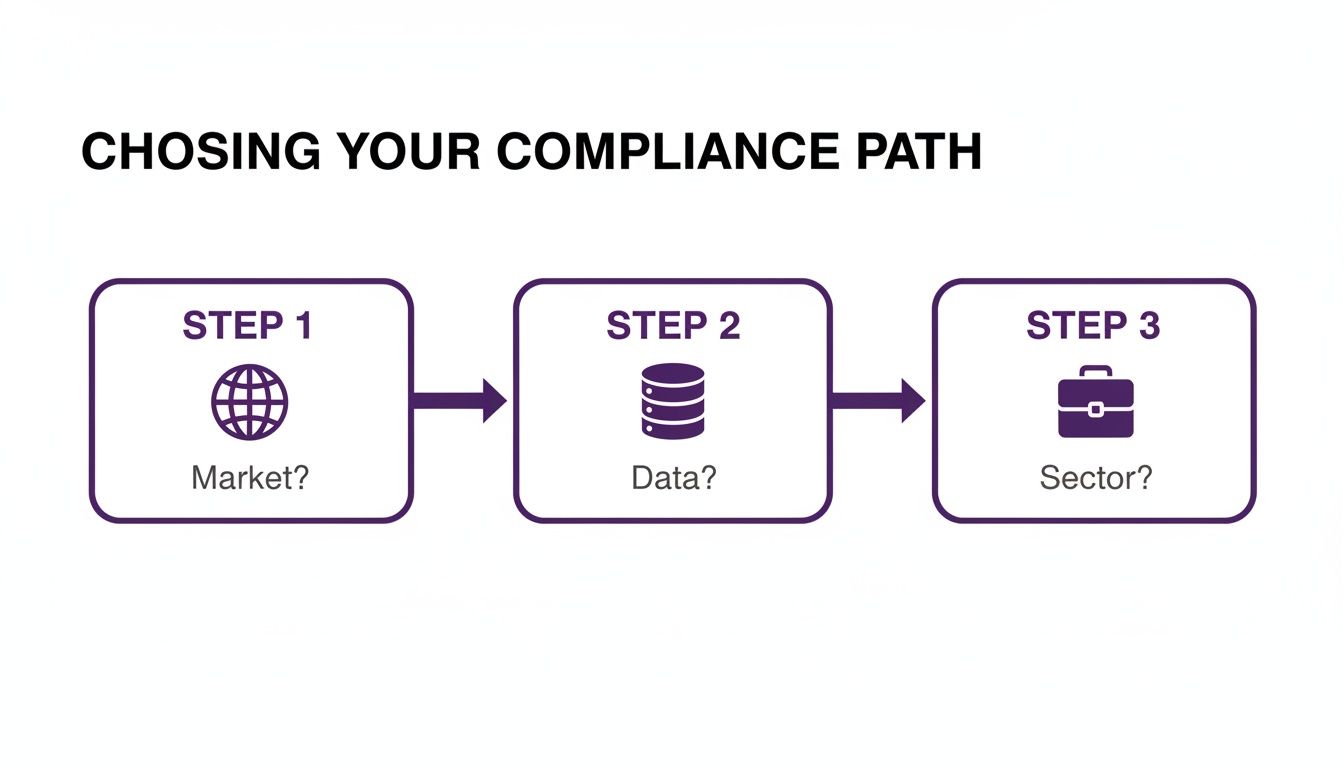
As you can see, your market, the kind of data you handle, and your industry are the primary drivers shaping your compliance roadmap.
Master Evidence Collection from Day One
This is where most startups fail. Evidence collection is often the most time-consuming part of any audit. You can have the best security controls in the world, but if you can’t prove it to an auditor, it doesn’t count.
Evidence is the tangible proof that your controls are working—screenshots, system logs, signed policies, meeting minutes. The secret is to collect this evidence continuously, not in a frantic scramble the week before the audit.
Your compliance program is only as strong as your documentation. Auditors demand a clear trail of evidence. Building this repository from day one is the single best way to ensure a smooth, successful audit.
Set up a centralized location—a secure shared drive or a dedicated compliance platform—to store all your evidence. Organize it logically by control. For an employee onboarding control, your evidence folder might contain:
- A copy of your background check policy.
- The signed offer letter acknowledging company policies.
- A screenshot from your HR system showing the employee's start date.
- A record of completed security awareness training.
For regulations like GDPR, keeping meticulous records is a legal requirement. Properly managing your records of processing activities is foundational. For a deeper look, you can explore our detailed guide on the GDPR register.
By establishing these practices—smart scoping, pragmatic controls, and continuous evidence collection—you transform cybersecurity compliance for your startup from a daunting project into a manageable, ongoing program. This approach not only gets you ready for any audit but builds a more secure and resilient business.
Automate Compliance to Save Time and Eliminate Errors

For a fast-moving startup, manual compliance is a recipe for disaster. It’s a tedious, error-prone process that pulls your engineers away from building your product and throws them into a black hole of spreadsheets and screenshots. That old-school approach simply can’t keep up.
Automation is the most effective way to turn cybersecurity compliance for your startup from a series of painful emergencies into a quiet, sustainable process humming in the background. It’s how you scale your security posture as you grow, without hiring a dedicated compliance army.
Connect Your Tech Stack for Continuous Monitoring
Modern compliance platforms integrate directly with the tools your team already uses, from your cloud infrastructure like AWS to identity providers like Okta and HR systems like BambooHR.
These integrations enable continuous compliance. Instead of manually checking if a new hire completed their security training, the platform gets an automatic notification from your HR system. Instead of taking screenshots of cloud configurations, it pulls evidence directly from your cloud provider’s APIs.
This creates an automated, real-time feedback loop.
- Automatic Evidence Collection: The platform continuously gathers proof that your controls are working, such as logs showing multi-factor authentication is enforced.
- Real-Time Issue Flagging: If a control fails—like a developer accidentally exposing a critical database—the system flags it for immediate remediation.
- Audit-Ready Repository: All evidence is automatically organized and stored, creating a "live" repository that’s always ready for an audit or a client's due diligence.
With this visibility, you can spot and fix gaps instantly. Compliance shifts from a reactive scramble to a proactive, manageable workflow.
The real power of automation lies in changing compliance from a once-a-year event into a continuous, operational state. It allows you to prove your security posture every single day, not just during an audit.
Tame the Security Questionnaire Beast
Security questionnaires are a founder's nightmare. These massive documents can stall a promising deal for weeks, putting immense pressure on your sales and engineering teams. Answering them manually is painfully slow and leads to inconsistent responses, inviting more delays.
Here, AI-powered automation is a game-changer. Modern compliance tools can read an incoming questionnaire and instantly draft accurate answers by pulling from your existing security documentation and control evidence.
Imagine turning a month-long manual slog into a process that takes a few hours. An AI can parse a 200-question spreadsheet, populate nearly all the answers, and flag the few that require a human touch. This not only saves an incredible amount of time but also arms your sales team to respond faster, maintain deal momentum, and close more business. It’s a powerful sales tool disguised as a compliance solution. Choosing the right tool is key, so it’s worth exploring the landscape of top compliance automation platforms to find what fits your needs.
By automating this critical part of the sales cycle, you directly link your compliance efforts to revenue. Your strong security posture becomes something that accelerates deals, not a hurdle that slows them down.
Sidestepping Common Compliance Pitfalls
Learning from others' mistakes is always cheaper. The path to compliance is littered with common traps that can waste your time, money, and morale. Knowing where these landmines are is half the battle.
Here are the most common missteps founders make and how to avoid them.
Pitfall 1: Treating Compliance as a One-Time Project
This is the most frequent mistake. Startups hustle to pass their first audit, get the report, and then shelve the entire program until next year. This “set it and forget it” approach is a huge risk.
Compliance isn’t a project; it’s an operational habit. Your security posture can drift out of alignment as you hire people, update systems, or deploy new code. An audit report is just a snapshot in time—your clients expect you to maintain that security posture every single day.
The fix? Create a simple compliance calendar.
- Quarterly Access Reviews: A scheduled check to ensure people only have the access they need.
- Annual Policy Updates: Refresh key documents like your incident response plan.
- Biannual Security Training: Run quick refresher sessions on threats like phishing and proper data handling.
This turns compliance from a frantic fire drill into a manageable, continuous rhythm.
Pitfall 2: Failing to Get Real Leadership Buy-In
If the leadership team sees compliance as just an "IT problem," your initiative is doomed. You need cross-functional support, and that starts at the top.
Real buy-in means leadership understands that compliance enables growth, not hinders it. They need to champion the effort, assign a proper budget, and communicate its importance to the entire company.
Getting the C-suite on board isn’t about scaring them with breach statistics. It's about framing compliance in business terms—how it unlocks enterprise deals, builds customer trust, and creates a genuine competitive edge.
Pitfall 3: Scoping Your First Audit Too Broadly
In their first audit, many founders try to include everything, thinking a wider scope makes for a stronger report. This usually leads to a chaotic, unmanageable audit that’s more likely to fail.
Your first audit should be strategic. Start with your core product and its essential supporting infrastructure. That's it. Leave out non-critical systems and dev environments. This minimalist approach lets you nail the fundamentals, pass with confidence, and build a solid foundation you can expand on later.
A successful, tightly-scoped audit is infinitely more valuable than a failed, overly ambitious one.
Pitfall 4: Underestimating the Documentation Grind
Auditors live by a simple rule: if it isn't documented, it didn't happen. You can have perfect security controls, but without a clear evidence trail, you won't pass. Many startups completely underestimate the sheer volume of documentation required.
This is made harder by the talent shortage. As of 2025, over 15,000 cybersecurity jobs in France remain unfilled, partly due to new regulations like NIS 2 and DORA. Finding in-house experts is tough. However, reports show that even with limited resources, SMEs that continuously assess their posture can boost their security scores by 19-25% within a year. This proves that disciplined documentation and steady improvement work. You can learn more about these cybersecurity job market trends in France.
The only way to win is to start documenting from day one. Use a centralized platform to collect evidence as you go, not in a desperate scramble before the audit. This discipline separates a smooth audit from a painful one.
Your Top Compliance Questions Answered
When you're building a startup, compliance can feel like a minefield. Let’s cut through the noise and tackle the questions I hear most often from founders.
What’s the absolute minimum compliance we need?
The "minimum" is whatever your customers demand.
If you’re selling B2B SaaS to U.S. businesses, SOC 2 is often the first major hurdle. If you're targeting a global customer base, especially in Europe, ISO 27001 is your passport to credibility.
Let your sales pipeline be your guide. The frameworks your prospects keep asking for in security questionnaires and contracts—that’s your minimum viable compliance. Solve the real-world problems that are slowing down your deals.
What will this cost?
The cost of compliance varies. A formal audit for SOC 2 or ISO 27001 can run from a few thousand to tens of thousands of euros for auditor fees, readiness assessments, and tools.
But the biggest cost is often the internal drain on your team's time. This is where modern automation platforms deliver massive ROI. By eliminating the manual grind of evidence collection and monitoring, they significantly reduce the total investment needed to get and stay compliant.
Remember, the cost of not being compliant—measured in lost deals, stalled sales cycles, and damaged trust—is almost always far greater than the cost of certification.
How long does a full audit take?
For a first-time audit like SOC 2 Type 2 or ISO 27001, budget six to twelve months from start to finish.
This timeline covers the initial gap analysis, implementing controls, a monitoring period to gather evidence (typically three to six months for a SOC 2 Type 2), and the final audit itself.
Subsequent audits are much faster. The secret to a painless audit is to start early and treat compliance as an ongoing practice. Using an automation tool can dramatically cut down that initial preparation time, getting you audit-ready much faster.
Ready to turn compliance from a roadblock into a revenue engine? Compli.st is an AI-powered platform built for startups. We automate security questionnaires, streamline risk assessments for frameworks like ISO 27001, NIS 2, DORA, and SOC 2, and help you prove your security posture to close bigger deals, faster. Stop losing time to spreadsheets and start scaling with confidence. Learn more at https://www.compli.st.